
Why Customer Support Still Matters in the Age of AI - ProductFTW #93
The problem is assuming that because most solutions can be automated, every solution should be.
I think there are two types of people in this world: people who seek help immediately and people who wait until they absolutely cannot solve the problem themselves.
I am firmly in the second group.
I don’t go to the doctor every time something feels slightly off. I take my health seriously and know what feels normal for me, so my instinct is usually to wait, pay attention, and see if the problem resolves on its own. If I’m actually seeking immediate medical attention, something is wrong.
My best friend is the opposite. If something feels wrong, she wants to address it. She would rather ask the question early, find out it’s nothing, and move on with her life.
I don’t think either approach is necessarily better. I do think we behave the same way as customers.
Some people ask for help the moment they encounter friction. They’ll search the help center, open the chat window, ask the AI assistant, or contact support before spending twenty minutes trying to figure something out themselves.
Then there are people like me.
By the time I contact customer support, I have tried everything. I have searched your website. I have read your FAQ. I have probably Googled the problem. I have clicked around your account settings looking for the answer. If I am finally trying to speak to a person, I need help.
Unfortunately, we’ve spent the last several years making it increasingly difficult to talk to a person.
Recently, I bought something online and accidentally ordered too many. I needed to return one, which should have been a pretty straightforward problem. Instead, getting to an actual person felt nearly impossible. Once I was able to reach someone, we talked through what had happened, they fixed the issue, and I walked away happy.
What stood out to me wasn’t that I had needed customer support in the first place. It was how dramatically my opinion of the company changed once I finally reached a person.
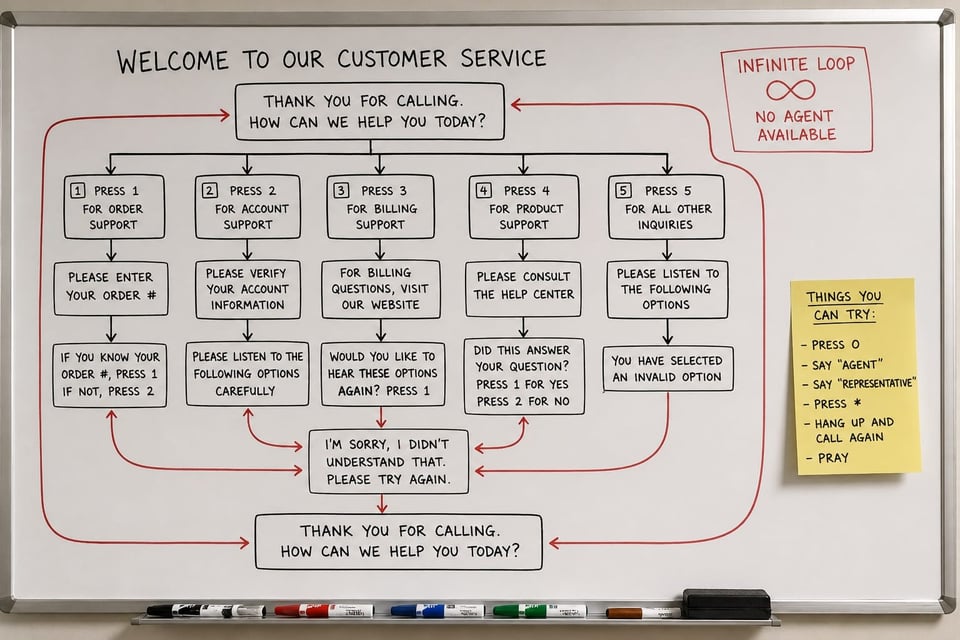
Back in my day, and apparently I am old enough to say that now, you could hit zero on an IVR and you would be forwarded to a person. Today, I find myself doing the digital equivalent: clicking “other,” rephrasing my question for the chatbot, typing “representative,” and occasionally rage-clicking buttons hoping one of them will reveal the secret passage to a human being.
I understand why we got here.
Most customer questions don’t need a person. If someone wants to know where their order is, reset a password, change their billing information, or understand a basic feature, we should make those things ridiculously easy to do without contacting anyone. AI is going to make self-service even better, and that’s a good thing.
The problem is assuming that because most solutions can be automated, every solution should be.
For someone like me, the decision to contact support already tells you something. I’ve reached the end of what I’m willing or able to solve myself. Sending me back to an FAQ I’ve already read isn’t making your support operation more efficient. It’s taking a customer who already has a problem and giving them another one.
That’s particularly strange when you consider how much effort we put into every other part of the customer journey.
As product managers, we obsess over onboarding. We map funnels. We remove friction from checkout. We test copy, buttons, notifications, and empty states. We spend an enormous amount of time thinking about how someone discovers our product, understands it, pays for it, and starts using it.
Then they have a problem after they’ve given us their money, and suddenly customer experience becomes someone else’s department.
I think that’s a mistake.
Customer support is still part of the product.
A support interaction is one of the few moments when a customer is explicitly telling you that their experience has broken down. That’s obviously an opportunity to fix the immediate problem, but also to rebuild trust. A frustrating experience can become a surprisingly positive one when someone feels heard, and their problem is actually solved.
Amazon has understood some version of this for years. I rarely need to talk to someone to return something because they’ve made the return itself incredibly easy. I don’t have to prove I’m eligible for a refund or navigate an elaborate support flow. The product handles the common case so well that I don’t need support.
That’s what good automation should do.
It should eliminate the need to ask for help when the problem is simple. It shouldn’t eliminate the ability to ask for help when the problem isn’t.
As AI becomes better at handling customer support, I think that distinction is going to matter more, not less. We should be designing incredible self-service experiences for customers who want an immediate answer. Give them good documentation, intuitive workflows, useful AI, and ways to solve common problems without waiting for anyone.
Then pay attention when someone is still asking for help.
That person might not be failing to use your chatbot correctly. They might be telling you that their problem doesn’t fit neatly into the options you’ve given them.
If you’ve spent the entire customer journey trying to delight someone enough to become a customer, don’t stop designing the experience once they need your help.
About ProductFTW
ProductFTW is a weekly newsletter about product management, with a focus on real-life experiences in startups. We want to help product leaders be successful by giving realistic approaches that aren’t for giant tech companies. We know you don’t have a full-time product designer on each team. We know your software probably hasn’t been used by millions of people worldwide–yet. We’re here to bridge the content gap from building your product and team to scaling it.