
The Skills AI Can’t Learn for You - ProductFTW #92
AI can make the work easier, but it can’t do the growing for you.
On the drive from the airport to fintech_devcon, Matthew asked me a question that caught me off guard.
“Do you think I push you too hard?” My answer was immediate. “No.”
The more I thought about it over the next few hours, the more I realized it wasn’t because he doesn’t challenge me. It’s because I don’t think that’s the problem anymore. As adults, we actually have the opposite problem.
Nobody pushes us.
When we’re younger, growth is built into life. School forces us to give presentations, work with people we didn’t choose, learn subjects we’ve never thought about, and constantly do things for the first time. Then we graduate, settle into careers, and eventually become good at what we do. If we’re lucky, we work with people who challenge us, but it’s surprisingly easy to spend years getting better at the same things without ever stepping outside our comfort zone.
I think product management is especially susceptible to this. We naturally become better at prioritization, stakeholder management, discovery, strategy, and execution because we practice those skills every day. That’s exactly what our jobs require. The downside is that we can mistake becoming more efficient for actually growing. Some of the most valuable skills in our careers–public speaking, writing, networking, telling a compelling story, and making difficult decisions–only improve when we intentionally put ourselves in situations that feel uncomfortable.
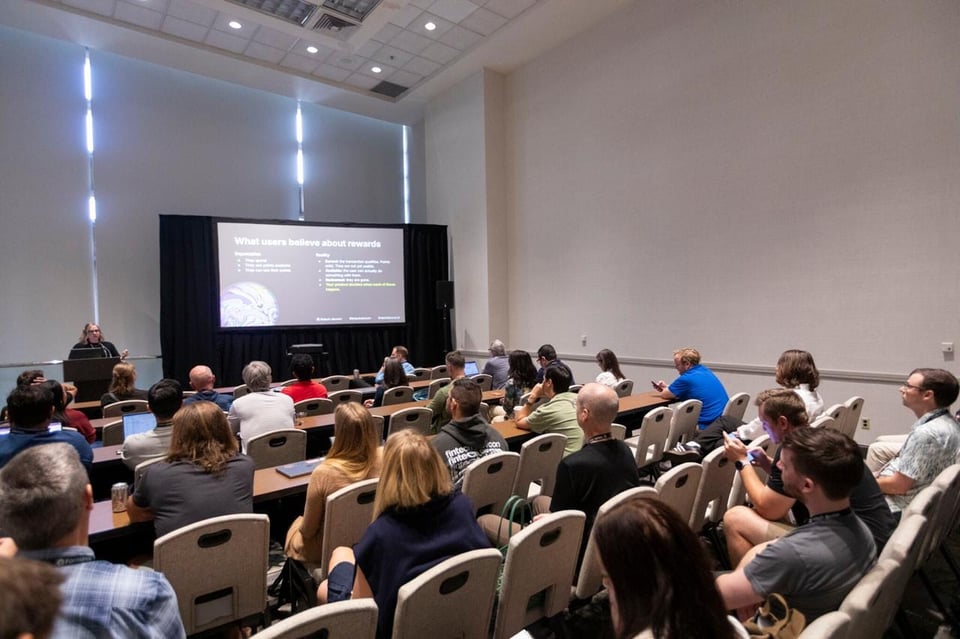
Fintech_devcon was my first solo speaker session. I had moderated panels before, but I was never at the center of the stage, sharing my experience, and that made me incredibly uncomfortable. When something is hard for me, I find it nearly impossible to dedicate time and effort to it. I want to run away from it. I will find 12 other things that suddenly seem more important and move it to the bottom of my to-do list until I absolutely cannot avoid it any longer. Preparing for this talk was no different.
AI is now good enough that when something is hard, you can avoid a lot of the tough parts and have it do the work for you. In truth, that’s exactly what I tried to do. I had AI help build my outline, turn it into slides, write speaker notes, and piece together the story I wanted to tell. I ended up with something that looked like a finished presentation, but I quickly realized I had let AI jumble up the entire point of my talk. I couldn’t remember why I was telling certain stories, I wasn’t retaining the material, and the presentation no longer felt like something I actually knew how to give, and it lacked authenticity.
What AI couldn’t do was turn my experience into a story that felt like mine. It could organize the material, but it couldn’t decide what mattered to me, make the story flow in a way that felt natural when I told it, or help me internalize it well enough to stand in front of a crowd without constantly trying to remember what came next.
At some point, I had to stop fighting with a prompt window and start using my brain. I had to decide what I actually believed, which stories were worth telling, and how I wanted people to feel when they left the room. Those decisions had to come from me, not AI.
As product managers, we’re going to keep finding new ways to use AI. It will help us write PRDs, summarize research, analyze customer feedback, create presentations, and probably do things we haven’t imagined yet. We should absolutely embrace it. The mistake would be outsourcing the parts of the work that actually teach us something. Producing better artifacts isn’t the same as becoming a better product manager.
A lot of what makes us better product managers doesn’t produce an artifact at all. It comes from talking to people, putting ourselves in unfamiliar situations, and being exposed to ideas we wouldn’t have found on our own. I felt that throughout the conference, especially when it came to networking.
It was easy when I was surrounded by my coworkers, but when I wasn’t, I had to put myself out there. At one point, that meant walking up to a group of strangers and asking if I could eat dinner with them. AI could have identified everyone at the table and given me talking points, but it never could have predicted the conversations we’d have throughout the night. None of them would have happened if I hadn’t walked up to the table in the first place.
It was another small reminder that the uncomfortable part was also the part that made the experience worthwhile.
By the time I got home, I was still thinking about the question Matthew asked me on the drive there. I don’t think he pushes me "too hard". I’m realizing that I need people who push me, and I need to keep finding opportunities to push myself.
As product managers, we’re trained to look for friction and remove it. AI is making us incredibly good at doing the same thing in our own work, and most of the time, that’s exactly what I want it to do. I don’t need to grow from every tedious task on my to-do list, but as we get better at removing friction from our work, I think we also need to get better at intentionally adding some of it back into our lives.
Sometimes something is hard because it’s tedious. Other times, it’s hard because we haven’t learned how to do it yet. If we use AI to avoid both, we also avoid the discomfort of learning something new.
Giving a solo talk was hard for me. Walking up to a table of strangers was hard for me. I could have made both experiences easier, or avoided them altogether, but that would have missed the point. The friction was where I actually grew.
I don’t want to become so good at removing friction that I also remove the experiences that make me better. AI can make the work easier, but it can’t do the growing for me. Those are the skills AI can’t learn for you.
About ProductFTW
ProductFTW is a weekly newsletter about product management, with a focus on real-life experiences in startups. We want to help product leaders be successful by giving realistic approaches that aren’t for giant tech companies. We know you don’t have a full-time product designer on each team. We know your software probably hasn’t been used by millions of people worldwide–yet. We’re here to bridge the content gap from building your product and team to scaling it.