
Do Startups Need Product Managers? - ProductFTW #70
“Do we actually need a Product Manager?”
If this conversation is happening, the answer is usually yes.
As a consultant, I am rarely brought in when everything is working perfectly. The call usually comes when something feels off, but no one can quite name it. The team has grown, and everyone is working hard, but output is inconsistent. Everything feels slower than it used to.
It is tempting to label this a communication problem. By the time the friction is obvious, they have already tried to fix it the logical way: more meetings, new Slack channels, tighter documentation, another project management tool. The instinct is to improve alignment by increasing communication.
More communication does not automatically create clarity. As the volume of conversations and artifacts grows, ownership becomes less visible, not more. When you pause to ask who is accountable for the product’s direction, the answer is usually some version of “we all are.” This is nice in theory, but if you are a RACI believer, there can and should be only one accountable party. I feel another post brewing.
Founder Overload
Early on, the product role is usually owned by founders who are passionate about solving a problem. They are monitoring Reddit channels, doing cold outreach, and directly relaying feedback to engineering. They make prioritization decisions in real-time, and everyone knows what is going on and is aligned on what needs to happen next.
As the company grows, a founder’s responsibilities shift. Fundraising, hiring, investor updates, partnerships, and long-term positioning need to be their focus. The product and users are still equally important, but are no longer the only thing competing for their time. Decisions start to be made between Zoom calls, slide creation, and answering Slack rather than consuming their entire focus. Feedback is still coming in from everywhere, but there is less time to sit with it, connect the dots, and translate it into clear priorities.
Founders believe they are still setting direction, and technically, they are. The difference shows up in how tradeoffs get evaluated. When product is no longer the primary focus, decisions are more likely to be shaped by the most immediate need. A large prospect’s request, a partnership opportunity, or a narrative that supports the next fundraise can and will swap priorities in the moment.
There is nothing wrong with this shift. Someone needs to be advocating for these new responsibilities. Without someone consistently focused on maintaining a clear product direction and long-term prioritization, it becomes harder to evaluate feedback in context and prioritize it deliberately, which can gradually turn into thrash and scope creep.
Why Engineers Notice First
Engineers usually feel the pain first. They are heads down shipping and responding to whatever the business needs most urgently. When priorities change frequently, work gets paused midstream or deprioritized after meaningful effort has already gone in. From their point of view, a lot of energy is being wasted without a clear sense of progress.
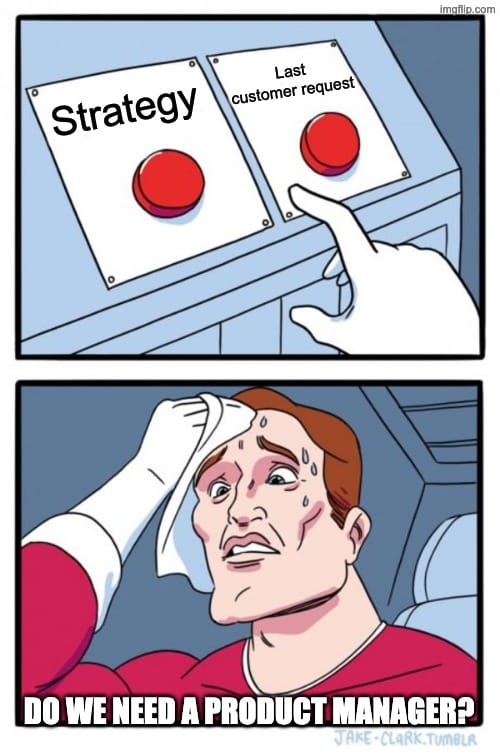
Most engineers do not just want to close tickets. They want to build things that matter. They want to see their work ship, stick, and drive impact. When direction shifts too often, it becomes harder to tell whether they are building toward something or just reacting to the loudest customer. That uncertainty is what creates frustration. It is not the workload; it is the lack of visible, sustained value creation.
The Two Common Responses
When founders sense this frustration, they typically respond in one of two ways.
Some attempt to course-correct by inserting themselves more directly into product discussions. They review tickets, attend more meetings, and make more decisions. That approach can provide short-term clarity, but it also makes the founder the bottleneck for product direction.
Others step back and trust the team to self-organize around priorities. In highly mature environments with a well-established strategy and strong product leadership, that can work. In growing startups, it often creates ambiguity. Everyone is already stretched thin and operating with partial context, even though they are fully invested in the company’s success.
Neither response holds up over time because neither addresses the underlying issue.
When You Need to Hire Product
You need to hire a Product Manager when misalignment starts costing real money.
Engineering time is spent revisiting decisions that were already discussed. Meetings increase because alignment does not hold. Teams ship work that is technically complete but does not actually solve the user’s problem. Engineers are busy, but if you ask what meaningful outcome their last few sprints created, the answer is not always clear. Customer feedback accumulates faster than it can be translated into real requirements.
You also see it in smaller ways. Roadmaps shift mid-sprint. Priorities change after a single customer call. Work gets half finished because something more urgent suddenly appears. Teams start optimizing for responsiveness instead of impact.
None of this looks dramatic from the outside. The team is still shipping, and revenue may even be growing, but internal costs are rising.
What You Are Actually Hiring For
This is where many teams get it wrong. A Product Manager at a growing startup is not there to run standups or keep a ticketing system organized. The role is not administrative.
You are hiring someone to own the problem space. That means they understand how the company makes money, how customers derive value, and how the product actually works. They have enough business context to push back when a request does not align with strategy, and enough technical credibility to earn engineering’s trust.
Ownership in this context means synthesizing feedback across sales, support, customers, leadership, and engineering. It means separating real patterns from one off requests. It means defining what success looks like before work begins and revisiting that definition after launch to determine whether the outcome matched the intent.
When this is done well, priorities do not stop changing, but the reasoning behind those changes is clear. Tradeoffs are explicit and work builds on itself. Founders can step back from daily prioritization without feeling like direction is slipping.
The Real Question
Startups do not need a Product Manager on day zero if the team is small enough that context spreads naturally. In the earliest stage, the founder can and should own product directly.
If this question keeps coming up in leadership meetings, it is usually not abstract. It shows up in how the company is operating. Decisions take longer than they used to. Alignment feels heavier. Tradeoffs are harder to reason through. That does not mean anything is broken. It usually means the company has outgrown informal product ownership. I have yet to see a team regret hiring product once they were truly ready for it.
At some point, someone needs to clearly own how vision turns into prioritized work and shipped outcomes. When that ownership is spread across too many people, the company is already paying for it. It just has not put a name next to it yet.
About ProductFTW
ProductFTW is a weekly newsletter about product management, with a focus on real-life experiences in startups. We want to help product leaders be successful by giving realistic approaches that aren’t for giant tech companies. We know you don’t have a full-time product designer on each team. We know your software probably hasn’t been used by millions of people worldwide–yet. We’re here to bridge the content gap from building your product and team to scaling it.
Part of the Product Management Leadership & Career Guide — ProductFTW's collected essays on the PM role, leading without authority, hiring, and getting hired.