
The Product Management Career Path - ProductFTW #84
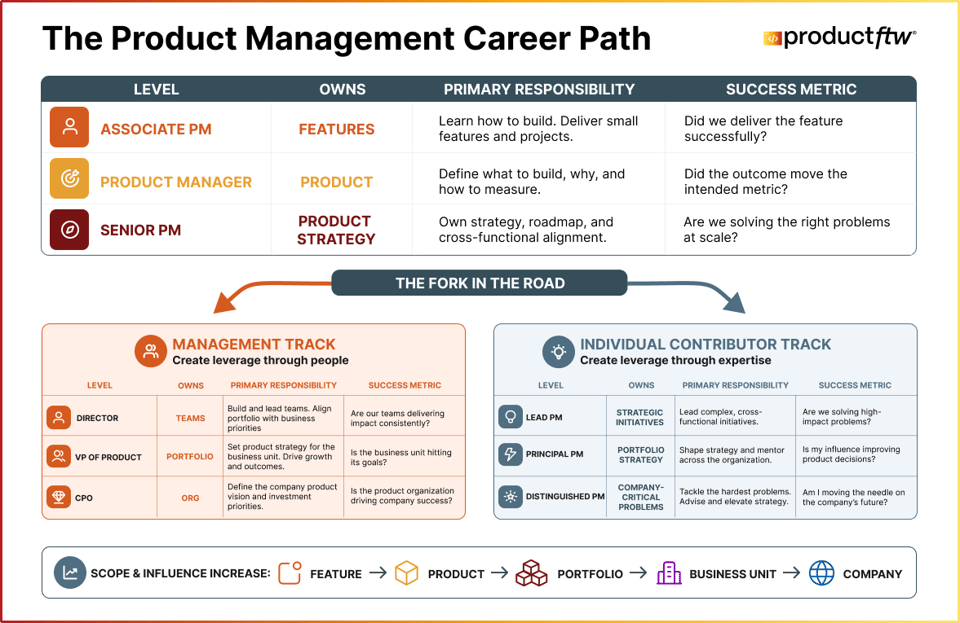
What changes over time is the scope of the problems or products you manage and how much of the strategy you own
One of the things I love about product management is that there is no single path into the profession. Unlike careers where there is a clear degree, certification, or entry-level role that everyone follows, most product managers arrive here from somewhere else.
Even though many companies now have Associate Product Manager programs, product management is not really an entry-level career. Most people spend a few years building expertise in another area before making the transition. Some come from engineering, others come from design, and many come from operations, analytics, customer support, project management, or marketing. The common thread is that they develop a deep understanding of a problem and eventually become interested in solving it.
What many successful product managers share is strong product taste.
I talked about product taste in Why Card Products Can’t Ship Like AI Products - ProductFTW #80, but in short, it’s the ability to recognize a great user experience. It is knowing what feels intuitive, what feels frustrating, and what would make a product more useful for the people who rely on it. Most product managers develop that sense by spending a lot of time living with the problem themselves. We often call it "eating your own dog food" because you become both the user and the person identifying opportunities for improvement.
That was exactly how I found my way into product.
My first role at CreditCards.com was called Product Information Management, but in reality, it was mostly data entry using a collection of legacy tools. My job was to take feedback from credit card issuers and update information across our affiliate websites to make sure everything was accurate.
The more time I spent using those systems, the more opportunities for improvement I noticed. I was training other employees, documenting processes, and working through the same workflows every day, which gave me a front-row seat to all of the friction in the product. Eventually, I started giving feedback directly to engineers because I could clearly see how the tools should work and where they were creating unnecessary effort.
At the time, I did not even know product management was a career. I simply knew that I was more interested in fixing problems than working around them.
Having worked with many product managers now, I’ve learned that’s how many get their start. They become the person who understands a problem deeply enough to see a better way forward and can communicate that vision clearly enough for others to build it. Regardless of where a product manager starts, career progression usually follows a similar path. What changes over time is the scope of the problems or products you manage and how much of the strategy you own.
Associate Product Manager
The first step into product is usually some variation of Associate Product Manager, Junior Product Manager, or Product Manager I.
At this stage, you are typically responsible for a small piece of a larger product or a relatively low-risk initiative. The goal is not to set company strategy or redefine the business. The goal is to learn how product development works while proving that you can consistently deliver results.
One of my first projects was helping replatform a small affiliate website. It was not a major business priority, and very few people outside the team paid attention to it, which made it the perfect environment to learn. I was given a few engineers and asked to figure out how we could modernize the site while ensuring it remained easy to maintain going forward.
That project eventually led to bigger opportunities because product careers tend to compound. Once people trust you to solve one problem, they start giving you larger and more important ones to solve.
The experience can look very different depending on the company. In a large organization, you are likely working closely with a senior product manager who reviews your decisions and helps you avoid mistakes. In a startup, you are often expected to learn much faster because there are fewer layers of support.
Product Manager
Once you demonstrate that you can consistently execute, your scope begins to expand.
Instead of owning a small feature or project, you begin owning products, larger business objectives, and more meaningful metrics. At this stage, someone else is still generally setting the broader strategy, but you are responsible for figuring out how to execute against it successfully.
For me, that transition happened when I took ownership of CardMatch, which is a product designed to match consumers with credit cards that fit their needs. The visibility and business impact were significantly larger than anything I had worked on previously, and success was measured by outcomes rather than simply whether a project launched on time.
This is where many product managers spend the majority of their careers. They become experts in prioritization, stakeholder management, customer discovery, roadmap execution, and driving measurable results.
Senior Product Manager
The transition from Product Manager to Senior Product Manager is usually when strategy starts to become a larger part of the job.
You are no longer focused exclusively on delivering features. You are thinking about why those features matter, how they connect to the company's broader goals, and whether there are better opportunities to pursue.
After CreditCards.com was acquired by Red Ventures, there was a major push toward personalization across multiple websites. My work expanded beyond individual products and into initiatives that affected an entire portfolio of products. That shift from managing a single product to influencing multiple products is often what separates a Senior Product Manager from a Product Manager.
At this level, you spend more time defining the roadmap than simply executing it. You begin to influence strategic decisions, evaluate trade-offs, and help leadership understand where the business should invest its resources.
The Fork in the Road
After reaching the Senior Product Manager level, most product managers eventually choose between two different paths.
The first path is management, where your primary responsibility becomes developing people and building teams. The second path is the individual contributor track, where your primary responsibility becomes solving increasingly complex product problems.
Neither path is better than the other. They simply require different strengths and interests.
In larger organizations, the split is usually very intentional. The management path leads through Director, Vice President, and eventually Chief Product Officer. The individual contributor path often progresses through Principal Product Manager and, in some organizations, Distinguished Product Manager. These roles often carry influence and compensation comparable to leadership positions, but they focus on solving the company's hardest product challenges rather than managing people.
Larger organizations also tend to create additional levels within both tracks. The management ladder does not simply move from Director to Vice President. Many companies include Group, Senior Director, Vice President, Senior Vice President, Executive Vice President, and other levels before reaching the executive suite. The same pattern exists on the individual contributor side, where organizations may have multiple Lead, Principal, or Distinguished levels.
The exact titles vary significantly from company to company, which is why I think it is more useful to think about product careers in terms of scope and influence rather than titles. As your career progresses, your responsibility expands from a feature to a product to multiple products and eventually to entire business lines, regardless of which path you choose.
The Management Track
The management track usually begins with the Director of Product.
These roles spend less time directly managing products and more time managing product managers. Their responsibility shifts toward coaching, hiring, resource allocation, performance management, and ensuring that teams are focused on the right priorities.
As you continue progressing through Senior Director and Vice President roles, the focus becomes increasingly strategic. You spend more time working with executive leadership, managing budgets, evaluating investments, and ensuring that product efforts align with broader business objectives.
When I became a Director, I was responsible for managing four product managers. When I eventually moved into a Vice President role, I was managing directors who were managing their own teams. The work became much less about individual products and much more about building an organization capable of consistently delivering great products.
The Individual Contributor Track
The individual contributor path is often less understood because many startups do not have a formal IC ladder.
In organizations that do so, the path typically progresses from Senior Product Manager to Lead Product Manager, and then to roles such as Principal Product Manager and Distinguished Product Manager.
What makes the individual contributor path unique is that your influence continues to grow without adding direct reports. In many cases, senior ICs are coordinating more teams and stakeholders than their management counterparts because they are responsible for solving the company's most important cross-functional problems.
A Lead Product Manager might lead a strategic initiative that requires alignment across half a dozen teams. A Principal Product Manager might help define strategy for an entire business unit while serving as a trusted advisor to executives and product leaders. Distinguished Product Managers are often brought in to address the company's most difficult challenges because they have built a reputation for consistently finding the right solutions and helping organizations navigate complex decisions.
While managers create leverage through people, individual contributors create leverage through expertise, influence, and execution. Their role is often highly consultative, and their ability to align teams that do not report to them is what makes them effective.
The Real Career Path
The interesting thing about product management is that the titles matter far less than most people think. Throughout your career, you identify problems, understand customers, work with teams to build solutions, and measure their impact. It is a lot of rinse-and-repeat, but the scope of your purview changes the higher you move up the ladder.
If you are looking to get into product management but don’t know where to start, you are probably closer than you think. Focus on the issues in your current role, interview your coworkers, and determine the best solution. If this comes easily to you and you are passionate about solving problems, it is time to start climbing the PM career ladder.
About ProductFTW
ProductFTW is a weekly newsletter about product management, with a focus on real-life experiences in startups. We want to help product leaders be successful by giving realistic approaches that aren’t for giant tech companies. We know you don’t have a full-time product designer on each team. We know your software probably hasn’t been used by millions of people worldwide–yet. We’re here to bridge the content gap from building your product and team to scaling it.