
Are Product Requirement Documents Still Relevant - ProductFTW #85
Revisiting ProductFTW #13 Two Years Later
Two years ago, Zach wrote Mastering the Art of Requirements: PRDs that Actually Work and made a strong case for why Product Requirement Documents still matter. His argument was that a PRD should not be viewed as a static document that gets written once and forgotten. Instead, it should serve as a living source of truth that helps teams stay aligned as a product evolves.
At the time, the conversation was largely centered around whether PRDs were too heavy for startups. Most early-stage teams are moving quickly, resources are limited, and nobody wants to spend weeks writing documentation that nobody reads.
I think that was a fair concern then, and honestly, it is still a fair concern now.
What has changed is the environment we are building in.
If you spend any time on LinkedIn or product blogs, you’d probably think PRDs are on their way out. Product briefs are popular, AI can generate requirements in seconds, and everyone seems to be looking for a faster way to communicate.
When AI first started showing up in product workflows, I assumed we would need less documentation. If a model could summarize meetings, generate requirements, write tickets, and even create prototypes, then surely the need for a detailed PRD would start to disappear.
What I’ve found is the exact opposite.
All Product Documents Are Trying to Accomplish the Same Thing
One thing I have noticed over the years is that product managers spend a surprising amount of time debating formats.
Should you write a PRD? Should you write a product brief? Should everything live in Linear? Should requirements be written as user stories? Should you just record a Loom video and call it a day?
Most of these approaches are trying to accomplish the same thing. They are helping a team understand what is being built, why it matters, who it is for, and what success looks like.
I've seen teams ship great products from a one-page brief, and I've seen teams struggle with a twenty-page PRD. I've also seen the opposite happen.
The difference is usually not the document itself. The difference is whether the team actually understands the problem they are trying to solve.
Why I Keep Coming Back to PRDs
I have experimented with many approaches over the years, and I always find myself coming back to some version of a PRD.
The reason is pretty simple. I think best when I write.
Every time I try to skip that step, I end up writing the same information somewhere else because I need a place to organize my thoughts. Writing forces me to identify gaps in my assumptions, clarify what is actually important, and think through the problem before I start asking other people to spend time on it.
Once the document exists, it becomes something I can use with engineering, design, executives, and stakeholders. I can walk through it in a meeting. I can turn it into a presentation. I can reference it weeks later when someone asks why a decision was made.
People process information differently. Some people prefer reading. Some prefer diagrams, and others need to talk through an idea before it clicks.
The PRD gives me a starting point that supports all those communication styles.
An Example
One reason I still believe in documenting requirements is that product problems are almost always more complicated than they appear at first glance.
Let’s say we want to build a repayment experience for a credit card product.
On paper, that sounds pretty straightforward. We want users to be able to repay their balance conveniently and accurately while maintaining compliance requirements.
In reality, there are months of work hiding behind that one sentence.
Users need to make payments, schedule future payments, connect bank accounts, understand their account standing, and know what happens when something goes wrong. Customer support needs visibility into repayment activity. Compliance needs disclosures and regulatory safeguards. Engineering needs integrations with external systems and a plan for handling edge cases.
What started as a simple repayment feature has now become a large cross-functional initiative.
Without a shared understanding of the problem, product, design, engineering, compliance, and customer support can easily end up solving different versions of the same challenge. Everyone is working hard, but they are not necessarily working toward the same outcome.
Documenting the problem early gives the team a chance to align on what matters before they start debating solutions.
AI Changed the Value of Requirements
The part I did not anticipate two years ago is how AI would change the value of requirements.
Historically, requirements existed primarily to help humans understand what to build. Today, requirements are increasingly consumed by both humans and machines.
What I’ve found is that AI has not reduced the need for documentation. It has dramatically increased the amount of information generated about a project.
We now have AI-generated meeting summaries, AI-generated tickets, AI-generated user stories, AI-generated test plans, AI-generated wireframes, and AI-generated prototypes. All of those things can be useful, but they also create a new challenge.
Every time information gets transformed, there is an opportunity for context to disappear.
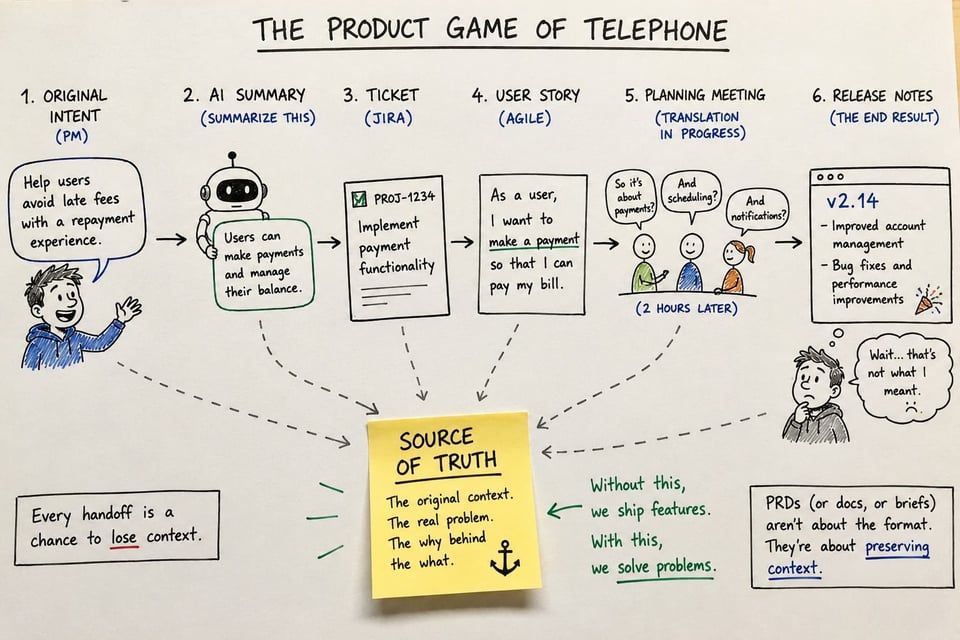
A meeting becomes a summary. A summary becomes a ticket. A ticket becomes a feature. A feature becomes release notes. The further you get from the original source, the easier it becomes to lose the details that actually mattered.
What I’ve realized over the last year is that I no longer really think of PRDs as documentation. I think about them as a way to preserve context.
When multiple people and multiple AI systems are generating outputs for the same initiative, having a single place to define the problem, goals, requirements, assumptions, and constraints becomes incredibly valuable. It allows everyone to continuously refer to the original intent rather than relying on increasingly summarized versions of the work.
In many ways, a good PRD has become one of the most valuable prompts a product manager can create.
The quality of AI outputs is directly tied to the quality of the information that goes in. A well-written requirements document can generate tickets, identify gaps in logic, create prototypes, and help build portions of a product.
What Changed
Looking back, I think Zach’s core point was right.
The value of a PRD was never the document itself. The value was creating a shared understanding of the problem so that everyone could move in the same direction.
Two years later, I still believe that is true.
What changed is that we now live in a world where information is constantly being generated, summarized, transformed, and repackaged by both humans and AI. What used to be a useful artifact has become an important anchor for preserving context.
Call it a PRD, a product brief, a strategy document, or something else entirely. What matters is that your team has a place where the original intent of the work can live.
That is what good requirements have always been about, and I suspect that will still be true two years from now.
About ProductFTW
ProductFTW is a weekly newsletter about product management, with a focus on real-life experiences in startups. We want to help product leaders be successful by giving realistic approaches that aren’t for giant tech companies. We know you don’t have a full-time product designer on each team. We know your software probably hasn’t been used by millions of people worldwide–yet. We’re here to bridge the content gap from building your product and team to scaling it.