
Product Requirements Document (PRD) Template - ProductFTW #86
What my PRDs actually look like, and why the format isn't the point.
Last week, I wrote about why I think Product Requirement Documents are still relevant. My stance is that I no longer really think of PRDs as documentation; instead, I think about them as a way to preserve context.
After publishing that article, several people asked what my PRDs actually look like.
The truth is that there is nothing particularly revolutionary about the template itself. If you search online, you will find hundreds of PRD templates that look similar. It doesn’t matter what the sections are or exactly how its formatted. What matters is how the document gets used.
Over the years, I have found that the most effective PRDs are collaborative documents. Product starts the conversation, but Product should not be the only team contributing to it.
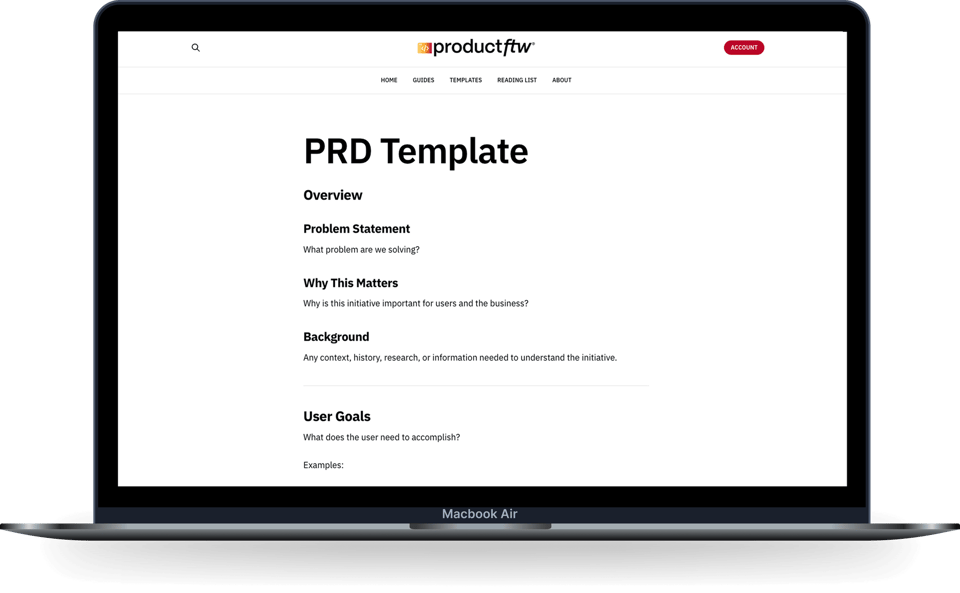
This is the PRD template I use most often.
Start With the Problem
The first thing I will write is the overview.
My goals are to clearly define the problem we are solving, why it matters, and any important context the team needs to understand before they start proposing solutions.
For example, if I were building a repayment experience for a credit card product, I might write:
Today, cardholders have limited visibility into their repayment options and upcoming obligations. Users frequently contact support with repayment-related questions, miss payment deadlines, or struggle to understand their current account standing.
This initiative aims to improve the repayment experience by helping users better understand their obligations, successfully complete payments, and avoid preventable delinquency events.
That statement sounds simple, but it immediately gives the team a shared understanding of the goal.
The focus is on the problem while avoiding implementation details such as buttons, APIs, or database tables.
Write User Goals Before Requirements
One mistake I see product managers make is jumping directly into requirements.
Before I start writing requirements, I want to understand what the user is actually trying to accomplish.
For the repayment example, some user goals might be:
- I need to understand how much I currently owe.
- I need to understand when my next payment is due.
- I need confidence that my payment obligations will be met on time.
- I need to avoid unnecessary fees and penalties.
- I need visibility into my account standing and repayment status.
- I need to quickly resolve repayment issues when they occur.
- I need confidence that my payment was successfully processed.
- I need to understand what actions I can take if I am unable to make a payment.
One thing I try to avoid is writing features as user goals. “Users need scheduled payments” is not a goal. “Users need confidence that their payments will be made on time” is a goal. Scheduled payments may be one way to solve that problem, but they should not be assumed before the team has had a chance to explore solutions.
Define Success Before You Define Solutions
Once I understand the user goals, I define how we will know whether we successfully solved them.
For the repayment example, I might identify success metrics such as:
- Reduction in late or missed payments
- Reduction in delinquent accounts
- Reduction in repayment-related support contacts
- Increase in successful repayment completion rates
- Increase in on-time payment rates
- Increase in users successfully managing repayments without assistance
I try to keep this section simple as another effort to help prevent jumping directly into solutions.
The goal is to create agreement around how we will determine whether the initiative was successful. If this section starts to feel like you are trying to build out a full reporting dashboard, you’ve missed the mark.
If the user goal is confidence that payments will be made on time, and the success metric is reducing missed payments, there are many possible ways to solve that problem. Scheduled payments might be one solution, but they should not be assumed before the team has had a chance to explore options.
Once I understand the problem, the user goals, and how we will measure success, then I start thinking about the work itself.
Use Epics to Organize Complexity
This is where epics come in.
For the repayment example, I might identify epics such as:
- Payment Experience
- Scheduled Payments
- Payment History
- External Account Linking
- Delinquency Management
- Customer Communications
At this stage, I am still not worried about implementation details. I am simply organizing the problem into manageable pieces.
Key Requirements Come Next
Only after I understand the major areas of work do I start writing key requirements that focus on what must be true for the experience to succeed. These are not my user stories, at least not yet.
Examples might include:
- Implement a Payments screen with navigation and sections for single payments and payment methods.
- Allow users to enter or select predefined payment amounts (Minimum, Statement, Current) and choose a payment date.
- Only one scheduled payment is allowed at a time; additional attempts show an inline error.
- … and more
I try to focus on business rules and outcomes rather than implementation details. (Are you noticing a theme?)
Map the User Flows
The last section I fully own as a product manager is user flows. The purpose of this section is to document how users navigate the experience and identify key decision points.
For example:
- User selects Pay.
- User enters payment amount or selects payment type.
- User selects payment date.
- User confirms submission
- Payment is scheduled.
- Confirmation email is sent.
This gives Design and Engineering a clear understanding of what the experience should accomplish before they begin designing or building it.
The Document Becomes Collaborative
This is where my process differs from many templates.
Once I have completed the overview, user goals, epics, key requirements, and user flows, I schedule time with my design lead and technical lead.
We walk through the initiative together.
At that point, Design becomes responsible for Design Requirements, and Engineering becomes responsible for technical and Security Requirements.
Rather than Product trying to write everything, the experts contribute their own requirements to the same document.
The result is a PRD that reflects how the entire team thinks about the problem rather than just how Product thinks about it.
Future Considerations, Dependencies, and FAQs
The remaining sections help preserve context as the project evolves.
- Future Considerations capture ideas that are important but out of scope.
- Assumptions and Dependencies capture external systems, vendors, approvals, and other risks.
- The FAQ section becomes a running record of important questions and decisions.
Over time, these sections often become some of the most valuable parts of the document because they explain why decisions were made.
Check Out the Template
The PRD template itself is simple.
The value does not come from having the perfect structure. The value comes from creating a shared understanding of the problem before the team starts building.
If you have been looking for a lightweight PRD template that works well for startups and growing product teams, feel free to steal this one and adapt it to your own process.
About ProductFTW
ProductFTW is a weekly newsletter about product management, with a focus on real-life experiences in startups. We want to help product leaders be successful by giving realistic approaches that aren’t for giant tech companies. We know you don’t have a full-time product designer on each team. We know your software probably hasn’t been used by millions of people worldwide–yet. We’re here to bridge the content gap from building your product and team to scaling it.