
Product, Project, Program Managers and Owners - ProductFTW #69
Someone told me recently that they were a “product owner,” and it sent me down the usual spiral of titles, responsibilities, and what people actually mean when they describe what they do.
Product roles have multiplied. As Scrum entered the workforce, agile became a job title, and now we have product managers, product owners, project managers, program managers, Scrum Masters, delivery leads, and more.
The titles keep expanding, but the core responsibilities haven’t changed that much. We’ve just sliced them into more specialized pieces. At the highest level, I believe there should be a clear division:
- Technology owns the “how”
- Product owns the “what” and “why”
- Everyone is responsible for the “when”
That’s the cleanest version of it. Everything else is nuance.
Let’s walk through the common roles and what they are actually responsible for.
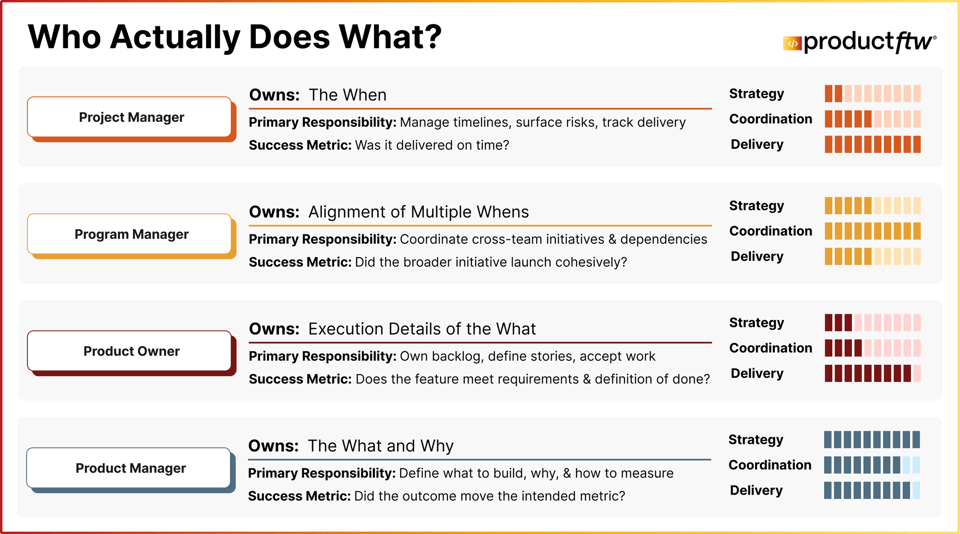
Project Manager
A project manager is responsible for when something gets delivered.
They partner closely with engineering to understand the plan, track progress, surface risks, and keep timelines realistic. They are not deciding how the system is built, and they are not deciding what should be built. They are ensuring there is a plan and that the plan is being executed.
Their success metric is simple: was it delivered on time? If not, did we know early enough to adjust?
It’s a critical role in complex environments. In early-stage startups, this role is often absorbed by product, engineering leads, or operations because there’s usually one main initiative and one engineering team. Once you have multiple teams or overlapping timelines, dedicated timeline management becomes much more valuable.
Managing time well is not trivial. It’s a skill. It’s just a different skill from defining product strategy.
Program Manager
Program managers operate at a broader level.
Instead of managing one project, they coordinate multiple related initiatives that roll up into a larger company objective.
For example, launching a new onboarding flow is a project. Launching a new card product is a program. It may include underwriting changes, compliance review, marketing updates, servicing workflows, reporting, and operational readiness. Each of those is a distinct project, but they must be delivered together for the product launch to succeed
The program manager ensures those moving parts align. Ideally, without 47 status meetings. They manage cross-team dependencies, escalate risks, and maintain visibility across workstreams.
Their success metric is not just whether something shipped on time. It’s whether the overall objective came together in a coherent way.
In larger organizations, this role becomes essential because complexity compounds quickly. In startups, it’s often handled by product, operations, or leadership simply because there aren’t enough parallel initiatives to require a dedicated owner. That’s where things start to get fuzzy, especially once Agile terminology enters the room.
Product Owner
Product owners are most commonly associated with a Scrum or Agile construct. In organizations that separate the roles, they focus primarily on execution.
A product owner typically owns the backlog. They write and refine user stories, define acceptance criteria, prioritize work within a sprint, and clarify requirements for engineering. They are responsible for ensuring that what gets built matches what was asked for.
They usually review work in sprint demos, accept or reject stories, and ensure the team meets the definition of done. At that level, they are responsible for making sure the feature works according to the requirements.
What they are not typically responsible for is company-level strategy, long-term product direction, budgeting, or defining broader business outcomes. That responsibility usually sits with a product manager.
You rarely see a standalone product owner in early-stage startups because the separation does not make much sense. When there is one product person, they are usually responsible for both strategy and execution. Splitting the roles too early just adds overhead.
Product Manager
Product managers tend to wear the most hats.
In addition to writing requirements and managing backlogs, they work with customers, conduct interviews, analyze data, define success metrics, shape the roadmap, and think about long-term direction. They are responsible for defining the “what” and the “why”.
They sit at the intersection of users, business goals, and engineering constraints. They are accountable for outcomes, not just output.
Where the distinction becomes clear is around responsibility. A product owner is typically responsible for ensuring a feature meets requirements and is accepted into production. A Product Manager is responsible for ensuring the team built the right thing in the first place and that it actually worked after it shipped.
That includes pre-production validation, post-production monitoring, and communication. Reviewing features in staging. Making sure edge cases were considered. Writing release notes. Watching metrics after launch. Answering the uncomfortable question of whether the thing delivered the result you said it would.
A product manager’s job does not end at “it shipped.” It ends at “did this move the metric we said it would?”
In startups, product managers often absorb project and program responsibilities because someone has to. In larger organizations, those boundaries become more defined. The core responsibility remains the same: own the problem, own the outcome.
Can These Roles Overlap?
Yes.
Can a product manager act as a project manager? Absolutely. It happens constantly in startups.
Can a project manager act as a product manager? That’s harder. Timeline management and stakeholder coordination are different skill sets from defining strategy, understanding customer problems, and shaping product direction.
Both are valuable. They’re just not interchangeable.
Do you need both or all of these roles? No. Make your Product Manager do it.
Where It Gets Messy
The confusion starts when titles become shields.
- “I’m just the product owner.”
- “That’s the project manager’s job.”
- “That’s not in my scope.”
In a startup, everything is your scope.
As companies grow, specialization makes sense. Clear role definitions make sense. Measurement clarity makes sense.
But the core concepts stay the same:
- Someone defines what and why.
- Someone determines how.
- Someone ensures it happens when it should.
- Someone ensures the pieces align.
Those are functions. The titles just describe how those functions are distributed.
The Real Point
The more titles you introduce, the more important clarity becomes.
Each role should know what they are accountable for and how they are measured. Otherwise, you create overlap without ownership, which is where things actually fall apart.
At the end of the day, product is about deciding what to build and why. Technology is about deciding how to build it. Delivery roles ensure it happens when it should. Coordination roles ensure it all makes sense together.
Everything else is how the organization chooses to divide the work.
Part of the Product Management Leadership & Career Guide — ProductFTW's collected essays on the PM role, leading without authority, hiring, and getting hired.