
Product Talks with Felix Del Rosario - ProductFTW #40
Talking product with Felix
For our seventh post in the Product Talks series, we’re featuring Felix Del Rosario, VP of Product at The Zebra. I first met Felix on the soccer field, proving you never know when or where you’ll meet incredible people. Though we’ve never worked together or even been in the same industry, it was fascinating to discover how similar some of our experiences are and how universal product methodology can be.
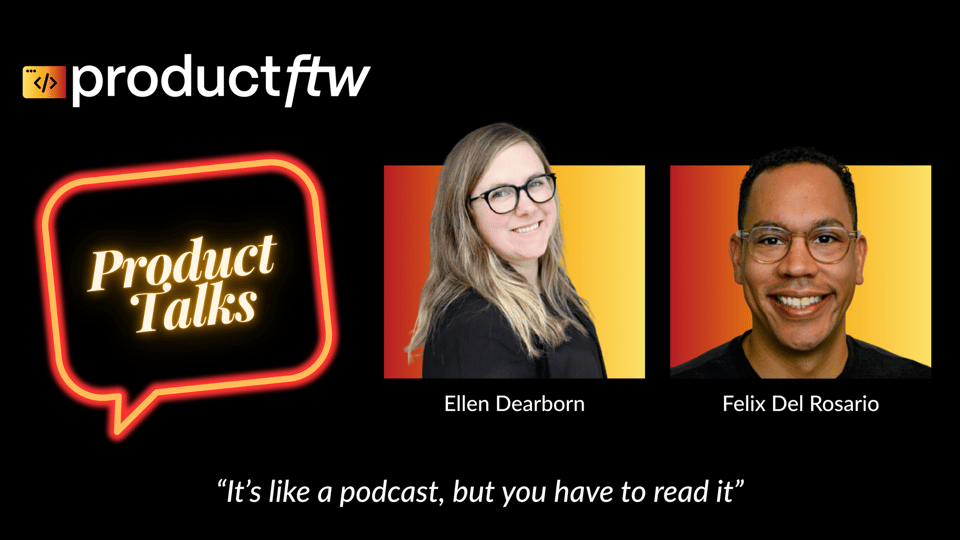
Ellen
Hey Felix, how’s it going? It’s been a while since we last chatted; what have you been up to?
Felix
Hey, yeah, it’s been ages! I've been at The Zebra for the last five years. I've been loving it. It's had its challenges, but I had been looking for such a long time for a place where I could be for an extended period, and this one has really worked out for me.
Ellen
You were at Indeed before, right?
Felix
Yeah, I was at Indeed until 2013. Then, I went to a company called Small World Labs, which is now Personify, I believe. After that, I went to Spare Foot, which is now Storable. Then I did a short stint at Web.com, and now I've been here at The Zebra for five years.
Ellen
Yeah, that's a lot of hopping around in a decade.
Felix
It was a lot. I moved here from the Dominican Republic, and I basically had to start my career again. What I had been doing there had not worked out for me in the US. I wanted to be a Project Manager or Developer, and neither of those careers were working. So I took an entry-level job with Indeed, and I just ran into someone who was a Product Manager, and they opened my eyes to the career.
I initially thought growth would come from switching positions, but now it seems like it comes from staying in one place for a long time to prove myself. Web.com was a place where I thought I'd do that, but that was a disaster. I did learn a lot, but I had to get out of there. And actually, at some point, they showed me the way out. They sold the business unit I was on. And then, after that, I left. The second spot I came to was The Zebra, and then I was like, “Okay, maybe this one will last five years.” And here I am! I could be here for ten years, and I’ll be happy.
Ellen
That’s amazing! For a little bit of background, could you please explain your role, where you're working, how large the company is, and what your team looks like?
Felix
I work at The Zebra, the United States’ largest online marketplace for insurance. I am a VP of Product, meaning I lead the Product practice, which includes Product Management and Design. The company currently has about 250 people, and my team has seven people and me.
Ellen
Wow, that’s a big team. Thank you. I do have a list of questions, but I’ll start with what you were just talking about: getting into product and what career path you took to become a PM. It kind of sounded like you were a Developer/Project Manager and then just had the right timing with Indeed and that Product Manager you met. Is there anything you'd want to add to that?
Felix
I think Product used to be a career people kind of fell into. Even when I fell into it around 2011-2012, it wasn't clear what I was supposed to be doing. You mentioned before we started that in the last 10-12 years, there’s been a development of content and content creators that have published all their knowledge from having been the first people that did this kind of product management, where we were all still figuring stuff out. But now, you can go to school and pretty much come out of school as a product manager. That wasn't something that people were able to do when I was starting as a PM. So the landscape has changed a lot. I think the Associate Product Manager position also has lost some relevance, which was how I started. It's just a different career to get into compared to when I did.
Ellen
What made you want to become a product manager?
Felix
One of the things that I struggled with as a project manager was leading projects that were, in my opinion, going to be unsuccessful. Project managers, at least in the capacity I had been in, don't get to decide if the project is done or not. You're basically asked to make sure the project stays on track, stays at cost, and that the resources are being used.
I’d always felt that the person leading the project could easily be the person making the decisions on what gets done and should be held responsible for that as well. While working at Indeed, I discovered that that combination was called product management. I immediately knew that that was what I needed to do. I found the way at Indeed; there was a role that opened up, and I went directly to the hiring manager and asked if I could have it.
Ellen
That’s awesome. And, when you talk about product management, what does it mean to you? Because obviously, there are kind of blurred lines between project management and product management.
Felix
Yeah. I'll answer your question and then give you more of the commentary that has been used and my problems with it. So, it can depend on where they work, but I'm going to stick with tech, B2B, B2C, or combos of those. But, product managers are responsible for understanding business needs and consumer/customer needs and translating those to business value. That is the biggest thing we do every day.
And yes, that involves managing projects, but it also involves talking to customers, getting on sales calls, interviewing people, and then translating all that stuff into viable, feasible requirements for your business that align with your business goals. Product managers have one of the most unenviable roles because they have to work with multiple teams and influence everyone without actually managing anyone, despite having “manager” in the title. And that is very hard.
They need to be good at framing, explaining, and aligning people, and they really need to be good at tying back what they did to the things they said they would do, like answering this problem for this customer, and also show that it connected to this business value that they promised. So that's the day-to-day. The key difference between a product manager and a project manager is (and again, I'm thinking from my experience being a project manager) that you weren't responsible for understanding the why behind the things we were working on; it was more so just making sure the things got done.
Something that has been permeated into our culture of product management is that we're all mini CEOs. And I get what people are trying to explain with that, that you are responsible for driving business or creating value for a business. But there's so much more to being a CEO. I think product people should be allowed to focus on the product alone. Once you start telling them that they’re mini CEOs, people with egos start growing into places and trying to do things that they shouldn't be focused on. Product people should be focused on addressing consumer needs to build business value.
Ellen
Wow. It is enlightening speaking with you because I feel like I've been in this product bubble, surrounded by people who have all come from the same cohort of product management. Sometimes, when I've been interviewing in the past for jobs, people haven’t really understood what product management is. And so to hear someone who's not in the fintech world at all and not in the same product realm that I've been in say the same things that I, and all my peers, believe in makes me feel really relieved. I sometimes feel like we're the only army that thinks that the product manager is not the CEO. Actually, the product manager needs the CEO to help with decision-making because PMs can't be responsible for everything. So it's really awesome to hear you say that because I have felt like it was just a small group of us who believed this, but it’s actually other people in the industry as well.
Felix
I'm glad that this is becoming more of a rallying cry for us and our craft. There have been things about product owners, managers, or leaders owning P&Ls, and I think it makes sense.
Again, I get why that has been a thing. You should understand how much work you're putting into the value you're getting out of things. But is owning the P&L and learning how to manage it the best tool to do that? I don't know.
Ellen
I think that's why I often see product managers who have aspirations of being CEOs or have been told that they should try to start their own company. But they realize very quickly that it's either for them or isn't for them. It can be a binary thing. You could just be a product manager, or you can just be a CEO, and it doesn't need to be intermingled at all.
Felix
Yeah.
Ellen
So the next question I have for you is, do you have any advice for new product managers?
Felix
I have a lot. It's very dependent on the context and the person, but generally speaking, I think putting your ego aside is very key in the beginning. Product managers do have a lot of influence, especially in product-led companies or product-centric companies. And you can get really hung up on, “I am a decision maker, and I am going to make things happen.” Early in your career, it's really important to just learn and absorb how businesses are run, how your business or where you're working is run, and the industry it fits into while you get at-bats with simple things.
Early on in my career, I got at-bats with relatively easy things like optimizing a funnel. It was really good to get a lot of practice just doing relatively simple work as a product manager while I learned the business and the industry I was in.
The other thing I would say is to learn from industry leaders. But I think you need a mentor who can help you filter out the noise as well. It's very easy to hear folks like Marty Cagan or even read one of those books, like Inspired or Transformed, that isn't even meant for ICs, and go into a company and say, this is how things are done. I think you have to be more pragmatic. Not all companies are on the way those books are written.
Ellen
Yeah, I feel like there's not enough focus on having your own PM style. Often, people are just trying to emulate what someone else has done, which is a good idea because they've done some really incredible things in their career, but unless you follow the same exact career path, it's not going to work out for you. So, you should be taking bits and pieces from everyone that you're interacting with and seeing how they've been successful and making it your own instead of just trying to copy it.
Felix
I agree. And then one more thing on this one: when looking for jobs, find a product that, especially early on in your career, you respect. There, you will probably find people that you respect, and you can learn from them as well. It makes a job search harder, I understand that. But I think it helps a lot to make sure that you establish your career at a place where believing in the product is not an issue and you can focus on the mechanics of product management.
Ellen
You just gave me a book idea, mixed with the talk about Marty Cagan—“Uninspired.” It's like that feeling when you're working for a product that you don't believe in, and you’re trying to make it come to life over and over and over again.
Felix
As a junior PM, that's very hard. Like, top of learning product, I have to survive.
Ellen
Exactly. And I don't even believe in it. So, what has been your biggest challenge as a PM, and how did you overcome it?
Felix
Early in my career, I had many moments of “I don't know what I'm doing,” and I didn't really have a network to help me see how I could change things or be better; it was very demotivating. I actually tried to get out of product management after having done it for a year and a half or two. But as I interviewed, people told me, “You are a product manager. You need to keep doing this.” So that was very challenging. I think the hardest thing for me was taking the step from just learning how to be a product manager to knowing how to do it and how to position myself to create value and not just practice with a product. And that part was really hard.
And then, deeper into my career, what's become harder is learning how to keep a team motivated, how to keep a team moving along in tandem with our business, and how to create alignment between our investors, our exec team, and the people working on the product. So, the challenges have changed, but there's always something that is hard to do. Hopefully, all of us are working in roles where if something is challenging, you're keen on learning about it.
In my career, there have been moments when I’ve wondered if the product was actually necessary, and that was also really challenging.
Ellen
Why did you find that challenging? I'd love to hear more about your opinion on that.
Felix
It's easy to hire a product person, decide what their work is going to be, feed it to them, and have them deal with the Scrum Master of the Engineering role, basically. And often, I felt like, well, what's my role then? When I pressed on that, people made it clear that my role was to just run the projects they had decided on. As you can remember, that's why I didn't want to do project management anymore.
Then there’s the lack of respect, too. I've worked at B2B companies where I tried to get in front of sales so that I could understand why the sales team translated customers' needs into individual, specific features that they wanted me to build. And they told me, “No, no, no, we talk to our customers; you don’t need to.”
I’ve never been specifically told there’s not going to be a product role, but the product role that I believe needs to exist is not allowed to exist. I think about that like, “Well, why do you have Product, and why am I here?”
Ellen
That is a very relatable experience, and it makes it even more challenging because you're then trying to justify your role while also creating value, which is really challenging to stay motivated.
Felix
I also look to the future, and I keep saying this, and it may be silly, but we went to the moon and there were no product managers involved. I have a strong belief that engineers can build products with good founders and good business-minded people. I have a slight fear that Product is not a 20-year career from where we stand today. So, I'm constantly looking at how we can continue to shape this and how I can influence how Product shapes itself, looking at the future as well.
Ellen
Well, to have a healthy argument, some would say that there were product managers. They just didn't have the title. Right? Because there always has to be someone creating value and figuring out the best way to do something. Sometimes, it’s an engineer who acts as a product person, but there's always product management. But it'll be really interesting to see where things go.
Felix
Hopefully, it enhances what we do, but we're still participating in that. That's what I'm trying to help out with.
Ellen
And AI is also led by product people, you know. But, moving on, what is a lesson you've learned as a PM that has changed the way you work, think, or collaborate?
Felix
I hinted at this earlier: humility. Again, we've wrested this title and this role at companies, and this theory that we’re mini CEOs didn't help either. I think just being humble and listening to your customers, your stakeholders at your companies, or whoever you're working with is a big piece of advice.
Ellen
Yeah. You know, it's funny you say that. At Totavi, we're a product-led company—we’re a consulting firm that helps people implement, basically. There are three of us who have been product managers, one who wants to become one, and someone who's product-minded. But the thing that we all have in common is that we're all a little bit self-deprecating. We have self-confidence, but we don't always believe in ourselves. So I feel like you need to have that natural balance of constantly questioning, "Is this good enough? Is this going to answer whatever the problem is?" Because if you think you're the best, that's when your competitors are going to overrun you, because everyone needs to think you're the best, not just you.
Felix
I agree. And you can do all of this with confidence; we don't have to have this feeling of imposter syndrome every second of our lives. One of the tools we use at The Zebra is Teresa Torres’ Opportunity Solution Trees. The reason they're really great is because they have a specific outcome you're chasing. And then you create your opportunities as leaves on a tree. Then from those opportunities, you create your solutions.
The next step is to list the assumptions you've made to arrive at that solution. Those assumptions become experiments that you run to check that solution. Then, when you arrive at that solution, and you're confident about it, the next step is to march that solution back up your tree to make sure it still aligns with the opportunity and that you still believe that opportunity addresses the outcome that you're seeking.
That process allows you to continue to check yourself: Am I making the right steps? Am I making the right decision? Am I listening? Am I understanding the changes and assumptions I have made, and how we've tested and have new data on those? It gives you a way to do that confidently. I love having tools like that where people are able to check themselves but do so while moving forward and not getting stuck in spinning.
Ellen
I love that. I haven't heard of that specific methodology, so I just took a note to look it up. I always love looking at new things like that.
Okay, well, you just mentioned one tool. Wow, you're right on—you must have had these questions ahead of time. But the question is: What are three tools you use every day that you would suggest aspiring PMs learn, understand, or buy? This could be a certain methodology you use, a software or a tool, or a specific agenda, et cetera. Pretty broad.
Felix
I’ll give you two sets because I use different tools now than I did when I was running a product every day.
So right now, the biggest, most important things to me are, well, this one’s silly, but Slack. Jira Product Discovery has been really good for us. It's basically like free-form roadmapping and you can use it as you want. It's worked really well for us. I'm a big believer, even in an Agile world or at least for the Agile principles, I think documentation is really important. I don't think we should do 80% documentation and 20% work, but there should never be 0% documentation, especially around the decisions that product makes. I love tools that allow us to document stuff. Right now, one of my favorite tools that allows us to run an end-to-end A/B testing program is Eppo, which allows us to create our hypotheses, run our tests with all the metrics, and then put our conclusions all in one place. It's this massive hub of all our learnings and all the things we've done on our product. So I love that one too.
That's from a leadership standpoint. I'm sure at the IC level right now, the tools that our teams are using would be things like I mentioned, the OST or Opportunity Solution Tree, which comes from Teresa Torres, who authored Continuous Discovery Habits. There are several tools in there that I'm probably forgetting, but the OST is the main one that we use. Our product lives and evolves around those trees, and the trees live in Miro.
Thinking more about how we create value, I think the scientific process is vastly underrated. And it's funny because we learn it in primary school, right? Create a hypothesis, test your hypothesis, and understand if it is true or not. So that process, which, again, I remember as the scientific process that we learned in elementary school, is a big part of how I think good product managers think about their work. I've also liked Strategizer's Value Proposition Design Canvas. I haven’t had an opportunity to use it too much, but I think any company or any product person that can get to that and use it every day, even product marketers or any type of marketer, I think it has the potential to create massive value for companies and consumers as well.
Ellen
Awesome. I love all those. How do you manage cross-functional work and communication across different teams, and how do you ensure alignment?
Felix
So, on the alignment piece, we create goals, and we forecast against those goals, and then those trickle down. Product is lucky because, at the company I work at, the product goals are the company goals It’s very product-centric. So, for us, it's almost natural. Where we struggled a bit is creating alignment around those goals with the rest of our stakeholders and the people we work with. But again, since they’re the company goals, that alignment becomes a little easier, too. Goals are the best way, in my opinion, to create alignment. I think goals can be interpreted differently by people. So, we have sessions where we explain and understand what the goals are. These sessions are at the level of actually working on creating the product; what do they mean, and why are they important? And everyone working toward those goals needs to understand those things. And some people care less, but at least then they've heard the spiel. And then, sorry, I stuck on the alignment piece. What was the first part of your question?
Ellen
Managing cross-functional work and communication.
Felix
That's so hard. We live in a world where communication is construed as a Slack message. And sure, that is a type of communication, but what is true communication? To me, it's something that is more than just a message. To me, it's a concept that you fully understand and get behind or can disagree with. That type of communication, for us, happens in working sessions, again, around the methodology of squads or trios leading the product end-to-end. We have a process that allows us to, around one outcome or goal, bring all the stakeholders together and create solutions. And I don't know if there's any other communication that matters more than that. We arrived at the solution, and we arrived at it together. We're all going to go together to where it is. And the alignment is created because we're all marching toward this goal. Then, you need to document that. As I said, we use Confluence or Jira Product Discovery for that.
Ellen
I'm getting the impression that you're very data-focused, which is amazing. Is this a cultural trait of Zebra, or is it something that you've had your whole career? Do you kind of foster the environment as you go?
Felix
I won't work for a company that isn't data-driven. So, as part of my interviewing process, earlier in my career, I would try to understand how good your data was, but that became less important than whether you use whatever data you have to make decisions. Indeed—being the first place I worked as a product manager—created a very strong feeling in me that this is the way to work. And it's been validated over and over at the other places I've worked at. In the places where I really liked it and the places where I've struggled.
Ellen
From the perspective of the startup world, you always lack data and have an abundance of need for speed. So, you try to bridge that gap to make decisions quickly, but also with very little data. So I love hearing about your experience because I'm like, man, that is like the pie in the sky for me. I would love an experience where it was like, yeah, let's do this whole tree, make assumptions, and actually build a test. Do you ever feel like you're pressed because of speed or the need to move quickly?
Felix
Yeah. And that's a good point. Earlier in my career, I thought data was all quantity. I needed to know the numbers and I needed to know how many people have used this thing and what numbers that produced. But smaller companies don't have that, right? They don't have that advantage. So I learned, too, that qualitative data is just as important, especially in those earlier phase companies or even earlier phases of products at mature companies. I'm thinking about a product that Google developed that had little traction; I think it was called Google Buzz, maybe ten years ago now. That didn't even have 1% of the usage that Google search has. I'm sure they created some set of signals from the data and/or talking to people that they were heading in the right direction.
Then, I think continuing to be ruthless about finding whatever signals you can to track against is also important. There's a story about a company that basically sold to white hat hackers, and it's a tool. But it’s not like they sell to hundreds of people or thousands of people; it's more like dozens of customers, but they pay quite a bit, so they don't need many. When they were trying to understand, from the data, what they should be doing, it was really hard for them to understand very clear actions like, “We caught this thing that was potentially a security problem.” They maybe had three of those a year. Imagine trying to develop that product as a product manager. But what they found is, out of three things that they discovered, there were dozens of rabbit holes that they had gone down and found nothing. They eventually found that one of the actions that seemed to be showing progress was copy-pasting. So they started capturing copy-pastes as a signal that the people using this product were finding value from it; they were copy-pasting stuff from this product to somewhere else. So they had way more copy-pastes than they did, like, “This security threat had been found.” So my advice there is to keep pushing to find leading indicators to the big things that you are or will be chasing.
Ellen
I love that example. What is the most rewarding part of being a PM for you?
Felix
When consumers get their needs solved. We just did this thing at The Zebra, where we started separating the reviews that we get from consumers buying through an agent from reviews we get from customers buying through our online product. We have an agency that helps us sell our policies, and they do a lot more sales than the online product does. But we've developed this online product in the last couple of years, and I really wanted to know how it’s doing and how people are reviewing it. And just this week, we got our first confirmed review from someone who purchased through the online product that we've been working so hard to build. And it said exactly what I thought we were doing for consumers: “It was easy. It saved me time. It saved me money. I was confident going through this product. Five stars.” I was like, “ Oh my gosh, this is it! We just need to do this a lot more.”
Bringing it back to my Indeed days, we launched this thing from a Hack-a-thon called Got a Job. When people finally landed a job through Indeed, they would come to this thing and say, “I got a job, and thank you so much.” It was just a steady stream on this subdomain we had created, and it demonstrated the value we brought to consumers, which was to get a job.
At Web.com, when you entered the office, there was a giant screen with a map of the United States. It showed the sales that we had generated from the customers we were selling our lead gen product to, and they would shine as dots on the map. And every day, I thought, this is what I'm helping. I'm helping small businesses be successful. To me, nothing else is bigger than that. As an individual contributor, as a leader, you don't have that many opportunities to drive those things directly.
It becomes more about the success of your team, both in what they do every day and in lighting up those dots on those maps or getting those five-star reviews. But also, every year, I celebrate the people who have stayed and continue to be in my product org; that’s massive to me as well.
Ellen
Yeah, it's a two-way street, right? They have to choose to want to continue to work for you, you know. What do you think the future of product management will look like? I know we kind of talked about it, but what do you think?
Felix
I don't know. It's kind of tumultuous now. I think it's so great that you brought up the whole book culture. For a while there, I was reading a lot of product books, and at some point, I was like, what am I doing? The best way to do this is just go do it. But some of us don't have that opportunity. So that's why books are good, too.
But I do think these early leaders, I'm talking like the 2000s, maybe late 90s, are starting to have an influence on how we shape Product. And to your point, a lot of those opinions are coming from larger, very successful companies. I mean, if you're writing a book, you have been successful. I think that we're going to get influenced quite a bit by that. Leaders and roles like mine are going to continue to have to be like, “Okay, but let's tone it down. Reality is more like this.” So I'm a little nervous about Product becoming this bland, homogenous thing that is done the same way everywhere because three or four people said that was the way to do it.
I'd like the future to be one in which we continue to create pockets of opinions, loosely held opinions, and strongly held opinions and discuss them. I love going to the product management subreddit on Reddit; it's grassroots product management at its best. I want to see that future continue to grow.
Ellen
I feel like the information is extremely valuable; I'm not discounting Marty Cagan or Inspired, or even Lenny; I can't pronounce his last name that starts with an R. But that was during the tech boom, and things were vastly different than they are now. Like, the tech boom has passed, and it's more difficult than ever to have a successful product. There's always a million of them where, back in the day, Google was one of three that were actually doing what they were trying to do and solving the problems that they were trying to solve. Now you're one of a million trying to solve these problems, and it just looks so different.
So, I am really curious to see how it evolves. I haven't been on the product manager Reddit. So now I'm thinking that maybe I could find some inspiration there because, in some ways, it feels like it's a dying art. But the core of a product manager is problem-solving. My sister is an artist. She loves to paint. For me, I feel like I am my most creative when I'm problem-solving. I can only do that through product management because I'm not the one who's physically building something, you know? And so it's my form of artwork.
Felix
That's a good way to put it. I was watching this video on TikTok of a trucker recording themselves from a drone going down this massive winding hill in Caprock, out in west Texas. And it was just beautiful. This guy was driving down this winding road and was in this amazing environment, surrounded by this canyon and all this red rock. And I was like, “I want to be a trucker.” It’s just a great thing when you're actually doing it—you know, you're driving, and there’s this scenery right in front of you, and look how beautiful it is, and you get to experience that. Obviously, these people also drive through the Midwest, which is just flat land. So, that video was an outlier. But yeah, I want to do tangible things, but I'm not great at them. And this is what is really great and what I found my passion in. I still think I'll be a barista at some point, maybe when I retire.
Ellen
But that's the dream, though, you know, when you get to create something physical. But I think our job is harder because you're not managing something that's physical; you're managing something that's very much intangible, and you have to predict the future at the same time. And so you're trying to pull on these threads, and who knows if it's going to come to fruition. My husband is a hardscaper, so he builds walls or walkways or whatever, and he's doing the same type of problem-solving, but he gets to do it physically. Our approaches to how we’d go about things are almost exactly the same, but they're two vastly different industries. So it's really interesting to know that my skills are transferable if I ever want to go somewhere or because I need to switch things up.
We just started a business, and I'm wearing the shirt today, Bucket and Blade. Part of it is regrading people's yards and whatnot. When you start a project, you have to go look at it and understand how it's going to work. How you're going to solve the problem, what equipment you need, and everything like that. Then you need to come up with requirements like, we need to get this here at this time, and we need to do this, and here's how we're going to measure the success. Like, did the water actually go into the drain? And so I think that there is hope for all product managers who feel like the industry is dying, that we've put ourselves in a position where we very much feel like the master of none. But the reality is we've really opened the doors to other industries for ourselves to step into and see that these skills are transferable.
Felix
That's true. And honestly, too, as you're saying, understanding the needs and the requirements but then the next step of doing something that is really hard to undo. With software, it’s like, okay, well, that didn't work. Stop the test, turn the feature flag off, whatever. So, I don't actually know how much I want to do the real world.
Ellen
Whenever I was trying to motivate my product management teams, and they felt like they were having crippling anxiety or something, I would be like, “Well, no one's life is at risk here. You're not messing with anyone's livelihood. So it's going to be okay if you mess up.” But yeah, you're right. In the real world, or should I say in the physical world, it's a little different.
That’s all my questions. I appreciate you sitting down with me today. You're such a fantastic speaker.
Felix
Yeah, no problem. This was fun. Thanks, Ellen!
About ProductFTW
ProductFTW is a biweekly newsletter about product management, with a focus on real-life experiences in startups. We want to help product leaders be successful by giving realistic approaches that aren’t for giant tech companies. We know you don’t have a full-time product designer on each team. We know your software probably hasn’t been used by millions of people worldwide–yet. We’re here to bridge the content gap from building your product and team to scaling it.
Part of the Product Talks series — interviews with experienced product managers across HopSkipDrive, Smartsheet, The Zebra, perigon°, ClosedLoop AI, and Totavi.