
Product Talks with Ellen Dearborn - ProductFTW #48
Talking product with Ellen, Product Principal at Totavi
For our ninth post in the Product Talks series, we’re talking to Ellen Dearborn, Product Principal at Totavi. As you’ll read, Ellen and I had a rocky start to our working relationship, as she was assigned to my team through a disruptive re-organization at Bankrate following their acquisition of Wallaby. We’ve come to be friends and colleagues, and Ellen is a key part of Totavi today.
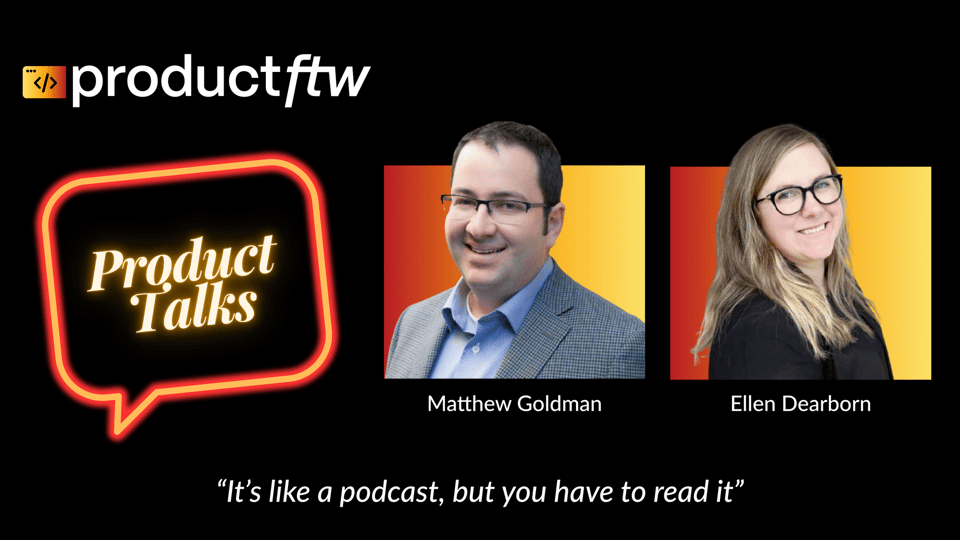
Matthew: What did you study at university and what did you first think you were going to do as a career?
Ellen: I studied international business in college, which I'm sure you did not know. When I was going to school, I was convinced I was going to become some kind of economist for another country. At that time, I was really interested in figuring out how money moved across borders. [laughs] Wow, I never even made the connection to where I'm at now. But at the time, I was sure I’d end up living abroad, figuring out how to do business with the U.S. from another country.
Matthew: So how did you end up being a product manager?
Ellen: I think the first time I thought that I wanted to be a product manager was when I was working at Bluefin Labs. Basically, the team was creating internal tools for social media listening. I would spend a lot of time with their product managers, giving them feedback, and I thought, “Oh, I could totally do this. I can see problems with tools. I am the user.” I think that was my first glimpse at what it possibly could be. At the time, I just didn't think I was capable. I was right out of school and had no idea what I was doing.
So fast forward to when I was working at CreditCards.com, a similar theme emerged where I was using internal tools, and they were terrible. I was constantly giving feedback to the engineering team, and through that, I kind of progressed into being a product manager when we didn’t even have the concept of product management. Then I found my first mentor. [Editor: This was Matthew.] He really showed me the light.
Matthew: How did you end up at CreditCards.com? What was the job you took there?
Ellen: I took a job as a product information manager and my job, very similarly to Bluefin Labs, was to take information and then put it into a system. I knew that I was capable of doing that, so I interviewed from thousands of miles away. I just desperately wanted to move to Austin, Texas. It was a lot of data entry. From there I progressed into product ops and then went into product management.
Matthew: I recall when Kamelia, who was the new CTO, joined, she did an Agile transformation project and through that you got product owner training, right?
Ellen: I did. I became a Certified Product Owner.
Matthew: Oh, no.
Ellen: At that time, I had the certificate and everything.
Matthew: I think this is an interesting aside. Having come into product through that strict Agile scrum methodology and then having had other experiences since, how do you think about the question, “What is a product manager?” Like, what does product management mean to you, and what are some of the key differences when you hear people talk about those roles, like their PM versus their PO?
Ellen: I think that this is a pretty frustrating conversation as a product manager because a lot of times you're going to be pigeonholed into a methodology rather than being able to do your job. Actually, prior to the massive Agile transformation, there was this really big push for lean product development. I don't know if you remember this, but we were sent to this lean product development course in the middle of Austin with a bunch of other product people and designers. We came back and had to use the lean product playbook, where they have those pieces of paper where you draw stuff.
Matthew: Was that before or after Kamelia joined?
Ellen: I think it's right as she joined, right before we went to Agile. The progression of my career was very much from data entry into leading teams on how to do things. Then really trying to figure out how we build technology rather than just being order-takers. The first stab at that was the lean product development and then the massive Agile transfer transformation.
There are themes that you pull from that in your career. I think that you should explore many different concepts of how to “do” product. As a creative thinker, problem solver, and strategist – which most product managers naturally are – you should pull in the approaches that resonate with you and have proven effective, and make them part of your own playbook, rather than sticking rigidly to someone else’s. I know you and I have talked a lot about Agile during the early 2010s. It was kind of like the “Agile Bible” or “Religion of Agile,” where people were just complete cultists. Being so rigid doesn't enable you to have the flexibility to actually build things. You're kind of crippled by the process rather than using it as an effective tool to be able to get your team to commit to timelines and actually build software.
Matthew: To use one of Kamelia’s favorite sayings, it's one of those things that is a hammer that makes everything look like a nail. People try to throw Agile at everything. We'll come back to this in the opposite interview, but when I was at Green Dot, we had a failed Agile transformation. That was my first Agile experience. A VP of app dev, he came in and tried to do it, failed, he got fired. Organizationally, it's not the right choice for everybody. Certainly, I think in the era when you were coming into product, it was extremely hot. I mean, it's still very prevalent.
Ellen: I don't think I've ever seen a “successful” Agile transformation, but I do think it provides a common language and framework for teams to work from. But then some people take it too far and ruin it. At every company I've worked at, I've only seen the ruins and not the actual benefits of it.
Matthew: So thinking about this early part of your career and product, if someone comes to you today, let's say they're 23, and they say, I'd like to be a product manager. What advice do you give them?
Ellen: I would say that they should do as many jobs as they possibly can. I actually recently had this conversation with my mom, where people equate product management or any technology role to a lot of money and want to know how one gets into that. My personal belief is that in order for you to be an effective product manager, you need a lot of practice at solving different problems and experiencing a lot of different pain points, so you can kind of connect it to you.
So if I was to give a recommendation to someone who is 23 or Julia [Ed: Julia Nicholls is Associate Consultant and person-of-all-trades at Totavi], I would say she's doing actually exactly what she should be doing right now. And although it might not seem like it, and it might seem really grueling, what she's actually doing is feeling the pain point of actual manual labor in the technology world.
Just like me starting with putting in information into a system while thinking, “This is super inefficient. How can I solve it?” Then you slowly progress into being able to solve it and then being able articulate those problems into solutions that technology teams can actually go and implement. In order to be a good product manager, you have to experience the pain yourself. It's always easier to start with a problem that is your problem rather than starting with solving someone else's problems because it's hard to build that empathy until you know what pain feels like.
Matthew: As you mentioned, you don't have a computer science degree. You don't have a technical background in the traditional sense. So how do you think about what makes a good PM and also, for yourself, you’ve become a leader of product managers and you've hired product managers. So how do you think about the need for technical backgrounds – whether it's good, bad, or indifferent – and also how have you developed technical skills over your career?
Ellen: If you're not coming from a traditional background, you need to have curiosity and leave your ego at the door. The most successful product managers I know are the most thoughtful when it comes to approaching a problem. I do not have a technological background but I also think I'm tech savvy. I got to this place just by being curious and not letting the fact that I don't know exactly how everything works prevent me from being curious enough to explore it myself.
In the past, I've asked supervisors to sponsor me in doing some online courses, which helped. For example, online coding courses for HTML because I just wanted to know more about how websites worked at that time. Or, getting API keys to play with. Just being able to play with tools helps you get an understanding for how they work and ultimately gives you the ability to solve for them later.
So although I've never created an API, now I would feel confident in doing so because I've been a user of many APIs, I've evaluated many, and I've also worked with a lot of SDKs. I think just downloading the software onto your computer, whether it's Postman or something else, and playing around with it and understanding the basics, is the best way to get to the technical background that you need as a product manager without physically coding.
And I think it's healthy that I don't have that background because I am too authoritative and it's hard for me not to cross into the “how” realm. So if I had more technical skills, I would for sure be arguing with my developers about the best solution. I like to know enough to ask questions, but not so much that I'm telling them how to do their jobs.
Matthew: When you think about the product managers you've hired and managed in your career, and whether they're technical or not, is there any theme? When you think about who your favorite one is or who were the most productive and successful, do they have technical backgrounds or, if not, what are their backgrounds?
Ellen: I'm looking for someone who can speak to all audiences comfortably and confidently. I don't know if I was necessarily looking for something on their resume that would indicate to me that they were technical. I think a good, well-rounded interview process gives them exposure to different people. Thinking through who I am selecting for their interview panels, I want them to feel like they can hold their own conversations without feeling like they're lacking in some way.
To answer your actual question: No, I was never looking for a technical background. And the thing that would be on a resume? Oh, well, that's complicated. I don't know if I was looking for one thing on a resume other than: Did you actually take the time to structure your resume well? Did it convey things clearly? Were there spelling errors? And it was less about your ability to do the job and more about did you check a series of boxes in order for me to get in front of you and feel like I could have a conversation with you that would indicate to me that you're a strong communicator? Because the number one thing as a product manager is you need to be able to communicate effectively. And that includes writing, so that would be the resume.
Matthew: Shifting gears a little. What do you think is one of your biggest challenges as a product manager? And what did you need to solve it? This is the question section where it sounds like you're getting interviewed for a job. Sorry.
Ellen: Yeah. I'm just laughing because some of mine are with you.
Matthew: That's fine. You don't have to hold back.
Ellen: Well, to toot my own horn.
Matthew: As you should!
Ellen: In all management scenarios that I've had, I've had a lot of friction with my managers. First, starting off with you. Then moving into Red Ventures. And then even when I moved out of fintech and into cybersecurity, I was actually interviewed for the same role that my manager ultimately ended up having. And so we interviewed each other, and they were pretty much like, are you cool with reporting to this woman because she has more cybersecurity experience than you, but we think you'd make an excellent product leader? I think that the biggest challenge that I've had is being really high performing and always managing my managers to make sure that they're not tightening my leash too much.
But do you want me to give an actual story?
Matthew: Yeah.
Ellen: Do you want me to give the story, or do you want me to choose a different story?
Matthew: You can choose whatever story you like.
Ellen: I like our story because I think that it shows that all relationships are redeemable. And that just because you're in a really trying situation doesn't mean that it's going to be like that forever and that it can turn into something beautiful. Like, our working relationship now, ten years? Thirteen years later, twelve years later?
Matthew: This would have been in 2015.
Ellen: Okay. Going from product operations into product management, it was basically the wild, wild West. At the time, in the industry, no one really knew what product management was and everyone was trying to figure it out, hence the massive transformations over and over and over again. Because I had worked really hard to be a loud voice at CreditCards.com, when Matthew joined the team and was Head of Product, I wasn't used to having a leader that one, had opinions; two, could actually provide me guidance; and three, was trying to move the company in a particular direction. And so, when Matthew joined, there were too many of us.
Matthew: Yeah. The essential problem with CreditCards.com was there wasn't a product team. There were some people who had had product owner training. As you did. And actually, the only person with the title of product manager was Vandana. And the CEO created a department out of thin air by transferring a bunch of people around and then seeing if those people could do the work, basically. Because again, Kamelia and her analogies, we were trying to rebuild a car while driving it down the road. Which is really hard. Like, we couldn't stop building stuff to go reset personnel or anything.
From my perspective, I didn't know anybody. Kamelia had shared her opinions with me, but I was also trying to be fair to people. I mean, I didn’t even know Kamelia that well at that time. I hadn't even interviewed her, which was this whole weird thing. I interviewed a bunch of people for CTO, none of whom took the job. Then they just hired Kamelia without including me in that part of the process, which I always thought was very funny.
I was trying to give everyone a fair shake by developing my own opinions, which is part of why it took so long for me to make personnel changes.
Ellen: I think in addition to those challenges that you're referencing, we also had a bunch of tech leaders who shouldn't have been in the positions that they were in. It felt like a hostile takeover by many of the other software engineers on the team by combining the two offices out of the blue. So there was already a lot of tension going on, and then having a new young guy come in with his own team and people that he favored. [laughs] You were a young guy then. It felt very much like an us-versus-them mentality. We felt like we had been doing a good job given the circumstances and the state of the technology and the cultural differences in the office, the deep Southern office.
So having someone come in and tell you that you're not doing a good job, that actually everything you've been doing is kind of crap, and that basically things need to change drastically right now was a really tough pill to swallow. I think especially because you weren't in the office, building those side relationships and instead you were coming to visit all the time. We had a lot of time to get together in the coffee room or the kitchen to talk shit, and that built a lot of toxicity within the office.
Maybe two months in, there was basically a whole push to get you out of your position and to take back the organization. You're talking about a bunch of 23 to 24 year-olds who feel like The Man's coming on them, and they have really poor leadership with more experienced people who are also hating on you. We're looking to them to help formulate opinions. There is just this undercurrent of “This guy is terrible. He's going to run our business into the ground.” Actually, if we had continued on probably for another year, we would have successfully done that ourselves without you.
What ended up happening is Matthew, over video initially, asked us, “What’s going on? I'm hearing grumblings from the leadership team that there’s a problem.” I remember being on video and all of us thinking, “We've been found out, and we're all going to get in trouble.” Because you were our direct manager. Yes, everyone was incredibly unhappy with you, but we weren't ready to tell you. I think the first time you approached it was on video, and we said, “Everything's fine. Everything's great. Everything's fantastic.” You got that Southern hospitality, which is funny because half of us weren't Southern, but you totally felt it.
Almost immediately, you came to Austin to visit and basically call people into your office to figure out what the problem was and how you could improve. I remember just being so stressed about it because I'm always the one that wants to give people the benefit of the doubt. Even now, my sister and I were just talking about this. If someone cuts me off, if someone hit me in traffic and ran, I would think, “Oh, they must be really busy.” I always give someone the benefit of the doubt.
In that moment, when you were coming around asking people, I thought, “Well, he deserves to know because how are we going to solve any of this if he doesn't know.” Pushing someone out without giving them an opportunity to fix things. I'm not really good with that, even though everybody else on the team was. In my mind, if you don't tell him, he's not going to know, and he can't get better.
Since this is my perspective of a really challenging situation and product leadership, I decided in that moment not to be a sheep. That you deserved to know what was going on, and then you could do with that information what you will.
I think it was around 5PM, I went into your office, and laid it out for you. And I blacked out. I have no idea what I said, but I was probably pretty harsh. Do you remember what I said?
Matthew: Oh, yeah. So my memory of this is that I came in and had everyone come into a conference room. I said something to the effect of, “I understand that everyone's unhappy. But you all won't tell me what you're unhappy about or tell me directly. You just go complain to everybody else. I can't fix problems that I don't understand. I'd appreciate it if everyone would stop lying to my face. Because that's what you're doing. I say, ‘Wow's it going?' And you say, fine, but the reality is it's not fine."
To your credit, you're the only person who came and told me what you actually thought. I mean, you did call me an asshole.
Ellen: Did I?
Matthew: Yeah.
Ellen: I can't say that I'm surprised, but I was so scared.
Matthew: It was fine. I mean, it wasn't a pleasant experience.
Hopefully, I thanked you. I think I did, because I think the only way to solve problems is to understand them. And then I knew that you were someone I could actually work with, whereas some of those other people, who I later moved out of the organization, were not people I could work with. I understood then that you actually cared about the business and about yourself and your job and weren't just playing the political games. I could have helped any of those people with the right attitude to become great product managers.
The other thing about that situation, for which I give credit to Scott Grimes, was when we were doing the reorg, he said that the real problem was I was so worried about how the people in LA were going to feel about being subsumed into a greater corporation. He said, “No. You're backwards. The people in Austin are the ones who are going to be really upset.” Because everyone thought that I had engineered a takeover.
Actually, Kamelia started the whole thing, insisting that she can't build technology without a product team and asking, “Why do you have this team of people in Pasadena who we can't interface with?” They actually could not have made me do this. I had a contractual term that said that if they changed my job from when they bought the company, that I could have quit and demanded they pay me out all my severance. That was years worth of salary for doing this so early.
But I always had success in my career by saying yes to challenging situations. I thought, I guess I'm going to do this thing instead of being a pain in the ass. I really regretted it for quite a while, though. [laughs]
Ellen: Yeah. I'm sure you did. Especially if you have a 24-year old calling you an asshole to your face, but that seems very on brand for me. But you did thank me. And then we ended up going to dinner with Nathan.
Matthew: I remember the funny in-between thing: Nathan was coming out to Austin for the first time and we met at the hotel to walk down to that whole strip of restaurants. Nathan had worked for me previously. I had known him for a while. I told him, “It's so bad. Everyone here fucking hates me.” He said, “That can't be true.” I'm like, “No. Literally just got told how much they hate me. Like, it just happened. It’s really bad here.” I was trying to set it up because I didn’t know how you all were going to react to him. He’s a new guy from LA we had just hired. We're walking down the street, and we run into you and Jeremy. Right?
Ellen: Yep.
Which is hilarious because Jeremy and I went to dinner to debrief on the fact that I told you that you were an asshole. Then we all ended up having dinner together, and that's honestly the only reason why I'm here today. I was like, “Man, if some guy can take that kind of verbal abuse and then go to dinner, that’s someone I want to know and trust.” And so here we are, eleven years later.
So I would say that's probably my biggest challenge and a theme that's been a challenge in my career. I think when you're high performing, it's hard to have someone tell you what to do. And you've always been really great at not really telling me what to do unless you needed it. You just say, “Figure it out.” Great. I will.
Matthew: Let’s move on to less emotional topics.
Thinking back to the people early in their career, what are some of the tools or things that you think people should learn so that they can grow their career? This could be literal tools like software or it could be books or it could be newsletters. Whatever.
Ellen: As a product manager, I would say the number one thing that you should start with is how to write a user story. I think that is kind of a microcosm for everything else you're going to do.
You need to be able to briefly and succinctly describe a problem and the outcome that you need, including the what, how, and why, in every different aspect of your job. If you can do that really well on the smallest part of the work, then you can do it at scale. I would say learning what a user story is, you can find it all over the Internet. Doing it well is the hardest part. And then once you unlock it, you're able to kind of make that story into being able to send an email, being able to get into a boardroom and give a presentation. It is the smallest place to start and, I think, the easiest place to start. But it is the most difficult to master.
Then I can give a bunch of different books and stuff that I found interesting, but I don't think that reading them and making your own style is the best way to do it. I think all product books are beneficial if you walk away with a little tidbit here, a little tidbit there. That helps you, but every job is going to be different.
Matthew: What is the most rewarding part of being a product manager for you? You could also answer this with something you shipped that you're really proud of.
Ellen: I actually think it's rare as a product manager to ship a bunch of stuff, like a whole product. Usually, it's pieces that do something cool. And sure, I have those stories. But I think the most rewarding part of product management is helping people.
Your business coach and I met once to discuss you, but then he also analyzed me because he can't help himself. He asked me, “What's your one driver?” You know how he did those Venn diagrams of your work and your personal life? One of the things that came out of that is that I have this strong desire to help people, and it doesn't matter what I'm doing as long as I feel that people are going to benefit from it.
At that time, especially with your coach, I always thought that I was going to go into something philanthropic. I have looked at jobs there, but the problem is they're almost too real for me, and I'm too empathetic. The emotional tax that I would pay is too high. So the thing that I love about product management is that I get to help people on my own terms - help them solve problems, help them make their life more efficient. That's my main driver.
So if I don't see the value in it, if I don't feel like we're solving a problem that's going to help people, then it is really hard for me to actually apply myself to do that.
Matthew: You've been in product for over a decade now. What are some of the key things that you think have changed over the past ten years, and how do you think it's going to change over the next ten years?
Ellen: I actually don't think that there has been a lot of evolution in product management over the last ten years.
Matthew: Spicy. Hot take.
Ellen: [laughs] Hot take. I think there's been a common theme of wanting to define what product management is and a really big push that everyone needs it. But as far as the role, I don't think the role has changed. People have always needed someone to come in, be able to articulate problems, and then help guide them in how to solve them. That always hasn't always had the product management title.
When I first got into product management, I don't think that people knew what it was and that, at the time, it was a really hot topic. Everyone wanted to do it. It made a lot of money, but no one had any idea what they were supposed to do or what it looked like. Over time, there's been many different variations on how to define that. But I feel like every time there's been a really big spike in trying to determine what it should be, we are actually defining it in a way that takes it away from its core, which is solving problems for people.
Instead, we need to make the role more important. Product managers need to make a big push to be a CEO of the company as was the trend five years ago and people need to be reminded that product managers aren't project managers, though at the core, they kind of are, as well. Every time the field has tried to evolve over the last ten years, it's always been evolving in making the role more than it truly is and adding on more responsibilities. Otherwise, I don't think that it's changed that much.
Matthew: Do you think it will change in the next ten years?
Ellen: I do. I think right now, we're in the stage where it's actually just about to start vastly changing. The addition of AI, in some ways, makes our job even more important. I know that people are really scared about AI coming in, but AI is not truly artificial intelligence. It still requires a human. As things are more automated, having a voice of reason, a voice of the user, and someone who can analyze the outputs and actually take whatever those outputs are and put them into an actual solution, is going to be more important than ever. I think that the product manager role will evolve with AI to be closely tied together, where it helps product managers do their job more efficiently.
Also, we are going to be more focused on data than we ever have been. Over the last ten years, we've always wanted to be hyper-focused on data, but it hasn't been as easy. Now data is going to be so easily accessible, we're going to be able to iterate much quicker.
Matthew: Alright. Thanks for chatting with me today!
About ProductFTW
ProductFTW is a weekly newsletter about product management, with a focus on real-life experiences in startups. We want to help product leaders be successful by giving realistic approaches that aren’t for giant tech companies. We know you don’t have a full-time product designer on each team. We know your software probably hasn’t been used by millions of people worldwide–yet. We’re here to bridge the content gap from building your product and team to scaling it.
Part of the Product Talks series — interviews with experienced product managers across HopSkipDrive, Smartsheet, The Zebra, perigon°, ClosedLoop AI, and Totavi.