
Product Talks with Jessica Marquez - ProductFTW #39
Talking Product with Jessica, Product Principal at Totavi
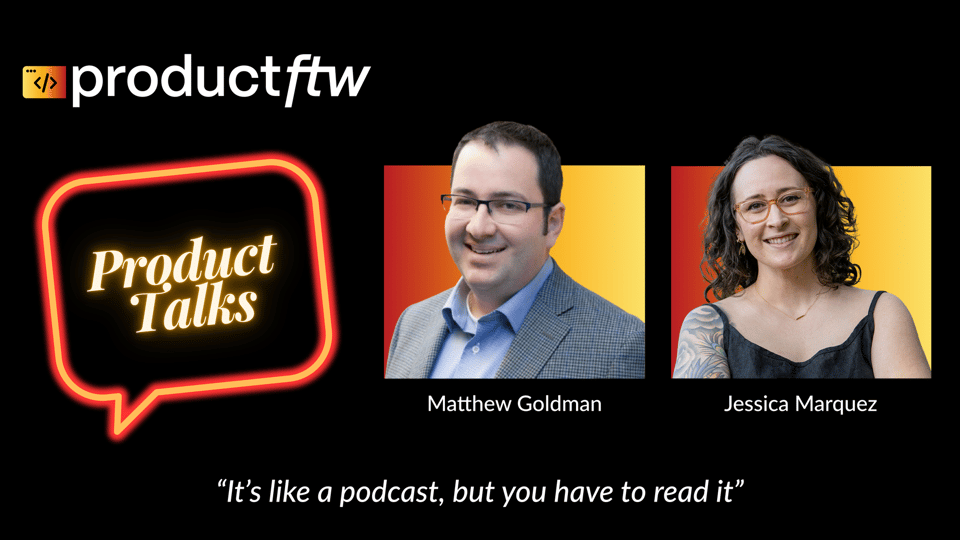
For our sixth post in the Product Talks series, we’re talking to Jessica Marquez, one of two product principals at Totavi. I’ll never forget when I first met Jessica and the amazing timing that led to her being my first product manager at Wallaby. Handing the product over to her was a huge step for me and she was the absolute perfect person for it. I loved reminiscing with her and love working with her today.
Matthew
What did you study in college? Did you know what product management was? Or, what did you originally want to be when you grew up?
Jessica
No, I didn't know what it was. When I was in college, I got my BA in Interpersonal Communications, and I wasn't sure what I was going to do with that. I had the opportunity to study at USC after that, and I got my Master's degree in Communication Management with a focus on Online Community Development. With that, I thought that I was going to build a career in social media management, marketing, and community development.
Matthew
How did you get into product from there?
Jessica
I started my career in social media management and marketing. In the second startup that I worked at, the CEO and Founder had a background in Product. Similar to many startups, he was our original product manager. While working there, I felt like I didn’t have a voice in the products that I was marketing, and I had developed opinions about what I thought would make for better experiences. In talking with him, we transitioned my role into a product marketing role, which allowed me to get involved in the product lifecycle earlier than when I was in a pure marketing role. Even then, it still wasn't the level of contribution and ownership that I really wanted, so I left and joined Wallaby.
Matthew
What made you want to join Wallaby?
Jessica
In my product marketing role, I had come to learn about product management, and that role felt more aligned with the level of contribution that I wanted to have in the products that I was working on. I was an early user of Wallaby, and I had met the team at a networking event. Not too long after that, I saw an opening for Wallaby's first product management hire. And here I am. The rest is history.
Matthew
Tell me about the rest of your career. What have been some of your other product experiences or other things you've done that led you back to product? That's a bit of a leading question. I know.
Jessica
I worked as a product manager for a few years, but then I got very interested in nonprofit work. So, I spent a few years doing volunteer work and was the Executive Vice President for a nonprofit. I feel like I was able to apply a lot of the skills that I built through my time as a product manager to the nonprofit organizations I was working with, particularly on the program development side of things. I thought that I might transition into nonprofit management and leadership long term, but I started to miss the tech space and missed building products that users were using.
I came back into tech and the fintech space in a business operations role at Apto Payments. The opportunity seemed like a great fit to blend all of my interests because I got to bring the skills that I had built up with the business operations part of my nonprofit experience, as well as all of the cross-functional collaboration that I think is such a big part of product management.
Matthew
Your degree is really interesting. I'm not familiar with the phrase “interpersonal communications” as a degree topic. But, in some of these other interviews we've had, people bring up that if they'd known then what they know now they would have gotten psychology degrees to become product leaders. So it probably served you well.
Jessica
I do believe that’s the case. A lot of what my degree learning was focused on skills for effectively communicating with people in different types of relationships and groups. I think it set the groundwork for being able to work with different types of people, with different personalities, backgrounds, and communication styles.
I was talking about Strength Finders with one of our clients, and my results lean really high in interpersonal skills and relationship skills. When we did Strength Finders the first time at Bankrate, I saw all my peers' results, and I felt like mine were almost not good enough. I felt like people had all sorts of other skills that felt so important to being a successful product manager. Over time, though, I realized that there is a big connection to storytelling (which was a big part of interpersonal communications) that has really helped me in product roles. Particularly in the ability to build a narrative and see the through line of all the things we’re building, as well as being able to understand different audiences and tell a compelling story that’s relevant to them.
Matthew
What are some of those skills that you thought you were supposed to have that you think are less important? Or maybe this goes to the technical versus non-technical PM question, but maybe better phrased, what are the skills that you think are most important for a product manager?
Jessica
I still get self-conscious about being a technical versus non-technical product manager, sometimes, because I don't feel like I'm wildly technical. There's also some perspective that I have to bring in for myself, though, that the level of technical understanding needed often depends on the products you’re working on. For some products, you have to be more technical, or else you won’t be as effective, and so maybe that’s not the best fit for the types of products that I’m working on. At the same time, though, there have been times when I’ve been very envious of people who had more of a data or CS background, who maybe came from engineering and then moved into product, and they just had so much of that background knowledge to pull from.
I’ve been fortunate that in the teams and the products that I’ve worked on, I haven’t needed a CS background to be successful. When you have a good technical partner, it’s more about the ability to understand concepts than being expected to be in the details of implementation. I even think for some projects, it’s been an asset not to have a technical background because the relationship between engineering and product can sometimes be tumultuous when you have a product manager who has strong technical opinions, and come too far into implementation. So, being able to know where your limits are while still leaning into the things you are good at to form those good partnerships is what I think ultimately makes product and engineering teams cohesive and successful in delivering the things that are most important to their users.
Matthew
What, at its core, does product management mean to you? How do you describe your job to people who aren't in the industry?
Jessica
I often use an analogy of air traffic control or the image of sitting on a fence post and thinking of the different parts of the greater team as being in lanes. Each team - the business team, the sales team, engineering, and design—has their own lane and really deep knowledge about the things happening in their lane, and they’re looking forward to where their areas are going. That’s not to say they can’t see other things around them, but they’re kind of on the ground level in that sense. I see product managers sitting on a fence post, where all of those different lanes come together, with their heads a little bit above where they can scan the horizon and help with coordination so that everybody can be successful and impactful. That way, engineering is building the right things, and we’re delivering things to sales when they need them, and we’re keeping the business informed and taking that exchange of information and knowledge while being able to see a bit more high level than anybody in any of those specific areas might be expected to do.
Matthew
What's one of the biggest challenges that you’ve had as a product manager? What was the story? How did you solve it or overcome it?
Jessica
I think one of my biggest challenges was my own self-confidence in the beginning. Especially because I felt like I was behind my peers in technical knowledge, and I had heard this narrative of product managers needing to be the "CEO of the product" and have all of these opinions right out of the gate. That’s not accurate, I think, in terms of what product managers need to be doing - particularly new product managers - and so I was getting in my head unnecessarily.
I think there's many components to product management, and while we all need to be able to do all of them, I believe that everyone leans into or enjoys one aspect most. There’s a strategic part: thinking about the future and what’s coming down the pipeline and looking through a futuristic lens. There’s a part that is a really tactical day-to-day view, where you’re focused on getting things done that need to be done. And there is also a historical component, focused on data and information gathering about your products, processes, or stakeholders. I think I lean more towards being a historian; I want to understand what’s happening in the product, take the visions of other people, make them happen, and figure out how to make all the parts work. There is still future thinking in that, to be able to take an idea of where you’re trying to get to and figure out what’s in between, but I didn’t have the confidence in that sort of future-thinking. I think I struggled because I took that lack of self-confidence and thought that it meant I was bad at it and, therefore, bad at this job. Luckily, I had a really great manager (Matthew) who recognized this about me and helped build my confidence in that.
Those two things coming together allowed me to gain some confidence and build that muscle a bit. It got stronger over time, too. If I could talk to a younger me, I would say that some of this confidence has to come over time; some of it has to come through experience. There are people who come expecting to know how to do everything immediately, but you just can’t. You have to have exposure.
Matthew
I think when we first had conversations about this, you probably weren't even 30 yet, right? I think there's a lot in there that's interesting. I talk a lot about this kind of thing in my strengths-oriented coaching approach; we’re not static as people. You’ve taken Strengths Finders multiple times, and your results have changed, as you know, as you’ve learned new skills. It’s also environmental. I can imagine that if I were you, at Wallaby, and the person who had come up with the idea out of thin air turned to you and said, “What’s next?” It would be pretty hard to answer, because it could feel like a trap, or you could feel like they should know because they were the visionary.
I think there’s a unique thing going on with founder-led startups. I’ve been doing these interviews with people who have been Chief Product Officers where they were told that they were meant to be the CEO of the product, and that’s a very dangerous position to be in—the CEO is supposed to be the visionary. Execution is the name of the game. What a product manager needs to be good at or do is not always the same thing. There are a lot of product managers, I think, who are lacking the skill you have of looking at what the data tells you. A lot of people build stuff that nobody uses. We don’t talk about that. People will say, “You’re so good at shipping.” And maybe that’s true, but did anybody use it? Did you have an impact, or are you just shipping stuff for the sake of shipping? If code ships in the woods and nobody uses it, did it even matter? I think having some humility about your ability to envision the future is actually really important. So that’s a good one.
We’ll switch gears a little and think more about the functional stuff: What are some tools that you use every day that you think aspiring PMs should learn or understand? And this could be software methodology, could be an agenda, it could be some other framework, could be any of that stuff.
Jessica
I would say basic data analysis. Going back to the data point previously made, you have to know how to do basic data analysis. You need to be able to navigate a spreadsheet. It's going to come up in so many different contexts. I think presentation skills, knowing how to build a deck for various audiences, and practicing written communication are wildly important, especially in this role where we’re working with different clients. Even if you're not in a consulting role, you're always going to come into a new company and need to adapt to new people and a new environment. So, while it's important to learn any given task management platform or project management tool, understanding some of the principles of good project management and good task management, like writing good tickets, is really important. You’re always going to live in a project management tool as a PM; that’s part of daily life.
I think a wiki or some sort of documentation is great. Not every company is going to have a really formal set of knowledge or processes or tools around knowledge management, but as a PM, you have to find ways to be a good steward of knowledge management. For some teams, that’s Google Docs, even though it shouldn’t be, but even if it is, at least try and be the best person at Google Docs and getting things in there, and at least try to keep your things structured. That way, if you can’t keep the whole company organized, then at least you can be a good example of what that structured documentation looks like so that when people interact with the things that you’re creating, you’re providing a high caliber of documentation.
Matthew
What are some of the ways that you manage cross-functional work and communication across teams? What are some of your tactics and strategies for ensuring everyone is aligned?
Jessica
The first one is trying to encourage public communication as much as possible in a way that makes sense within the organization that you're in. It's really easy for one-to-one or one-to-a-few communication to happen, but having a communication platform like Slack or Teams and having public conversations so you’re creating a reference history for new people coming into the conversation. It’s a way for people to catch up, like if an executive or a leader isn’t responding to every conversation and they need to catch up or follow along and see what things are happening. When you’re having conversations in public, it’s easier for people to see things that are going on so that people can be more broadly informed.
In general, I think you should be looking for opportunities to tell your product story as much as possible. Whether that’s in cross-functional team meetings, or if you have an all hands, or wherever those places are, know what the narrative of your product is and what you’re focused on; that way, you can keep people aligned and your whole team knows what they’re building toward. I think that as a product manager, you spend every day in that story, so it’s easy to assume that everybody knows it as well as you do. It’s easy to forget that people are not in that same story every day. So, even if it feels like you’re telling the story over and over and over again, that’s how you get people to know what’s happening. I guarantee nobody else hears it as much as you do.
Also, finding opportunities to have asynchronous updates that make sense for your team is very helpful. So, if that’s weekly updates about what’s been happening or what your goals are, what’s being delivered, whatever cadence your company uses, just be as clear as possible about what’s coming down your pipeline and how you expect that to impact different parts of the business.
Matthew
What was the most rewarding part of being a product manager for you?
Jessica
I think the most rewarding part is when the team has an “Aha!” moment with you once you complete a task or ship something. Going back to that fence post analogy, as a product manager, you see all of the different stuff coming down the lanes, you’re out there telling the story of what you’re building and what you’re trying to achieve, and the people hear the story and go along with it. The rewarding part is when things finally come together, and you have a product launch, and the team gets to see and use it for the first time, and they finally get to see how everything came together and feel the impact of their hard work, and you get to see their spark of an, “I get it!” moment.
Matthew
So how has product management changed for you over the last ten years, if you think it has at all? Or do you think it's going to change over the next ten years as a profession?
Jessica
I think it's partially hard to tell because my role as a product manager has changed so much. It’s so different. I used to work on a single product, but now I work on multiple products that are all in different phases or stages. There’s a commonality for sure, but they also have different needs in some way. I feel like AI is a super common answer.
Matthew
It is common, but it's not inaccurate.
Jessica
And it doesn’t feel like a, “Go do my job and replace me.” thing, but (and maybe this is a bad thing to say), part of the reason that I thought about moving away from product management is because it can be a very taxing job. You go from talking to so many different types of people that take different types of communication, and you’re doing all different types of tasks. I think it’s a very heavy context-switching job. So, I think one of the things that is challenging for me is to have my brain be in the right mode at the exact time that I need to be able to get a specific type of work or task done. Utilizing AI tools as a partner in helping me get there has really changed my general mental load and energy with the job. Being able to use it to help ideate, to kind of get the juices flowing, or to help me start down a path. It’s not going to do my whole job, but it’s been so impactful for helping me get in the right direction. In addition to all of that, it’s also brought a bunch of efficiency to my day-to-day.
Matthew
Yeah, I mean, it's okay to say AI. Well, that’s all of my questions. Thank you for your time, Jess.
About ProductFTW
ProductFTW is a weekly newsletter about product management, with a focus on real-life experiences in startups. We want to help product leaders be successful by giving realistic approaches that aren’t for giant tech companies. We know you don’t have a full-time product designer on each team. We know your software probably hasn’t been used by millions of people worldwide–yet. We’re here to bridge the content gap from building your product and team to scaling it.
Part of the Product Talks series — interviews with experienced product managers across HopSkipDrive, Smartsheet, The Zebra, perigon°, ClosedLoop AI, and Totavi.