
Decisions Without Context Don’t Scale - ProductFTW #76
A product manager’s guide to avoiding last-minute delays
We have all been there. It is late in the sprint, engineering is wrapping up, QA is testing, release notes are ready, and the team is moving toward the finish line. Then something happens, like last-minute stakeholder feedback, and the release slips.
From the outside, these delays almost always get blamed on engineering. We have all sat through retros trying to explain what went wrong. Over time, a pattern starts to emerge. Many delays do not originate in engineering. They start earlier, with product indecision.
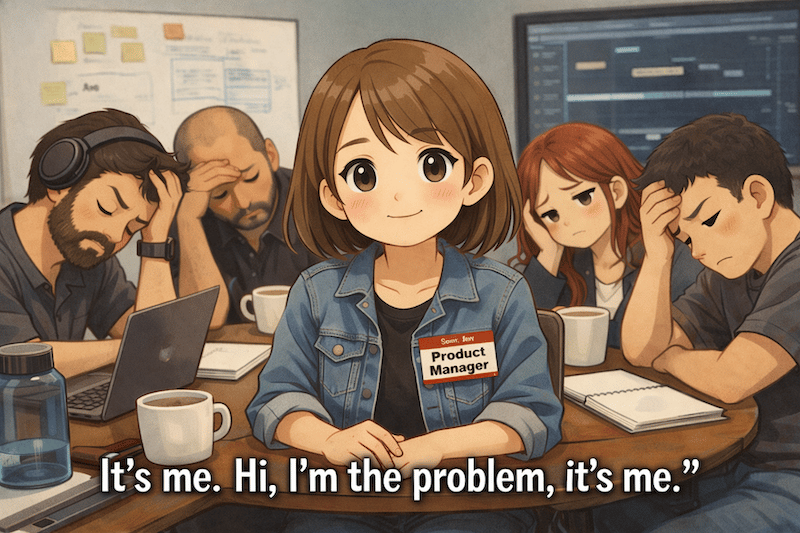
This is not to say every delay is a product problem. Unexpected issues do happen. The point is that product has more influence here than we’d like to admit. When your decisions are unclear or revisited too late, the impact shows up at the end of the sprint.
Where delays actually start
A lot of delays come from decisions that were never fully made or never clearly documented.
This has happened to me. I was building a new onboarding flow for a credit card. During design, someone suggested adding a save and return later feature. It sounded like a great idea and a reasonable improvement for users.
As we dug in, we noticed that many competitors do not offer this feature in their application flows. The complexity started to become clear. Saving drafts would require storing sensitive personal data before an application is complete. That introduces additional security risk, expands compliance scope, and creates more operational overhead.
I made a straightforward decision: we were not going to support draft saving. Users need to complete the application in a single session and, if they drop off, they start over. The tradeoffs were clear and I documented the decision.
What happens without decision clarity
A few months later, as we were approaching launch, I did a demo for stakeholders and someone immediately asked whether a save feature should be added.
I had documented the decision months prior, so the response was straightforward. The team already evaluated this as a feature and made a conscious tradeoff decision. Unless something materially changed, the decision would stand and the team continued forward.
I’ve also been in the position where I didn’t document a decision, and that's when things start to unravel. When you can’t recall why the team said no, no one is fully confident and the discussion is reopened.
Design may start revisiting flows while engineering evaluates the new scope, and QA may need to consider new test cases. A single question can turn into real work across the team and it always happens at the worst possible time.
Tips and Tricks
There are a few practices I consistently rely on to reduce indecision and rework.
- I keep a decision log. Nothing fancy. Just the decision, the rationale, and the date. I cannot tell you how many times I have gone back to it when someone asks, “Why did we do it this way?"
- I make sure my meeting notes capture outcomes and context, not just what people say. A decision without context is not that useful. I always think about what will be most useful to me when I come back to it a few months later. If all I see is “we decided not to include the save button,” I will have no idea what that actually refers to or why we made that call. Without context, it is almost guaranteed that we will question it or revisit the decision.
- I write product briefs that explicitly call out what we are not doing. This part matters more than people think. When something is intentionally excluded, I want it written down so it does not creep back in later.
One thing I've learned to look out for is perfectionism. Sometimes the delay is not confusion or a lack of documentation. Sometimes it is me wanting to get everything exactly right before we ship.
I have caught myself trying to account for every edge case or revisiting small details that are not actually blocking the core experience. In those moments, I have to ask whether I am improving the product or just slowing the team down.
In many cases, the extra time does not lead to better outcomes. It just delays getting the product in front of users and pushes the timeline without adding real value.
How I stay on track
When things feel messy, I try to fall back on a simple framework to keep myself grounded.
- I set decision deadlines so things do not stay open forever. If a decision is made, I treat it as final unless new information comes in. Opinions alone are not enough to reopen it.
- I write the rationale every time, even if it is just a few sentences. I know I will forget the context later, and someone else definitely will.
- I make a point to communicate decisions clearly so no one is surprised down the line.
- I keep coming back to the core user problem. If a discussion does not clearly connect to that, it usually is not worth the time.
- Lastly, when I am unsure, I default to shipping the simpler version. I would rather learn from real users than keep guessing internally. (Read more about the simple version in ProductFTW #61.)
Sometimes a delay really is an engineering problem, but if it keeps happening, take a look at your product decisions upstream.
About ProductFTW
ProductFTW is a weekly newsletter about product management, with a focus on real-life experiences in startups. We want to help product leaders be successful by giving realistic approaches that aren’t for giant tech companies. We know you don’t have a full-time product designer on each team. We know your software probably hasn’t been used by millions of people worldwide–yet. We’re here to bridge the content gap from building your product and team to scaling it.
Part of the Product Requirements Field Guide — ProductFTW's collected essays on the six phases of writing requirements, from problem definition to launch.