
Good, Fast, Cheap - ProductFTW #62
Why the Old Product Triangle Still Holds Up
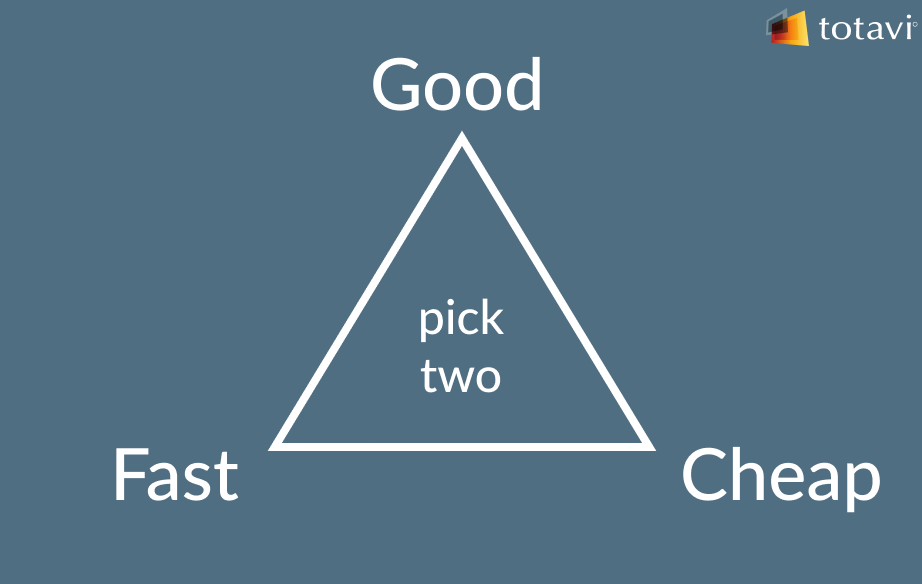
There’s an old adage: Good, Fast, Cheap—pick two.
I first saw this on a sign at my barbershop growing up in a small town. These guys were super old school; they were sometimes just gone fishing or golfing, and they changed the price by updating the tiny paper sign with white-out or ink rather than making a new one.
Some folks seem to feel like you no longer have to make this trade-off, but I absolutely still think you do. Sure, modern tools, frameworks, and AI make it easier to move faster, but they don’t erase the triangle; they just shift where the corners sit. Beyond just being aware of it, it’s a useful tool for navigating trade-offs and aligning your team.
Let’s review Good/Fast/Cheap through the lens of modern software development and product management.
The Triangle, Reframed for Product
- Good = Quality: smooth UX, thoughtful architecture, low tech debt, solves a real problem
- Fast = Time: how quickly you ship, learn, and iterate
- Cheap = Resources: budget, team bandwidth, and opportunity cost
While you may not have to choose only two, you certainly cannot excel at all three. By being aware of the tradeoff, you can force clarity into your preferences and approach.
Good/Fast/Cheap in The Real World
As a fun experience, let’s look at what each of the combinations might get you in the startup world.
Good + Fast (Not Cheap)
You hire a strong team, buy the right tools, and move fast. Results:
- Users are happy
- You ship on time
- Your burn rate goes up
This is the playbook for venture-backed startups going for speed over efficiency. (Although, if things don’t go well, these companies wish their burn rate had been lower!)
Fast + Cheap (Not Good)
You throw together an MVP using no-code tools and junior talent. Maybe you vibe-code with AI now. Results:
- You test the idea quickly
- You don’t spend much
- The result is fragile and doesn’t scale
This approach is useful for internal tools, prototypes, or early-stage experiments. It aligns with the MVP-style approach or the adage that “if you’re not embarrassed by your first version, you worked on it too long.” I might also refer to this as the version YC promotes.
Good + Cheap (Not Fast)
You invest in open-source tools, optimize for code quality, and avoid shortcuts.
- It’s robust and maintainable
- It doesn’t break the bank
- You’ll be explaining delays for a while
I’m never into this one; it feels unlikely to actually work. I have no good examples.
Why Are Trade-Offs Important?
Because trade-offs are the core of product leadership.
If you’re not consciously choosing which corner you’re sacrificing, you’re probably doing it accidentally. That’s when timelines slip, expectations misalign, and teams burn out.
This triangle gives you a shorthand for talking about those trade-offs out loud:
- “Are we OK with rough edges if we launch next week?”
- “Do we need to spend more to avoid cutting corners?”
- “Should we delay to get this right?”
It’s not a constraint; it’s a conversation starter.
How to Use Good/Fast/Cheap
- In planning: “Which two are we prioritizing this sprint?”
- With execs: “We can ship faster if we spend more: Do we want to?”
- During reviews: “We got Good + Cheap here, but we knew Fast would take a hit.”
Use it to set expectations. Use it to justify decisions. Use it to avoid surprises.
Because your users don’t care how you built it. They care that it works. Just make sure your team knows what it costs to get there.
About ProductFTW
ProductFTW is a weekly newsletter about product management, with a focus on real-life experiences in startups. We want to help product leaders be successful by giving realistic approaches that aren’t for giant tech companies. We know you don’t have a full-time product designer on each team. We know your software probably hasn’t been used by millions of people worldwide–yet. We’re here to bridge the content gap from building your product and team to scaling it.