
Product Talks with Meredith - ProductFTW #34
Talking Product with Meredith Brown, VP, Product Management at Smartsheet
For our third post in the Product Talks series, we chatted with Meredith Brown. She is another former AT&T Interactive colleague of mine (are you sensing a trend)? Meredith stood out to me immediately as a super-sharp product leader and moved from AT&T to Salesforce and ultimately to Pantheon as CPO. We spoke just before Meredith started in her new role at Smartsheet.
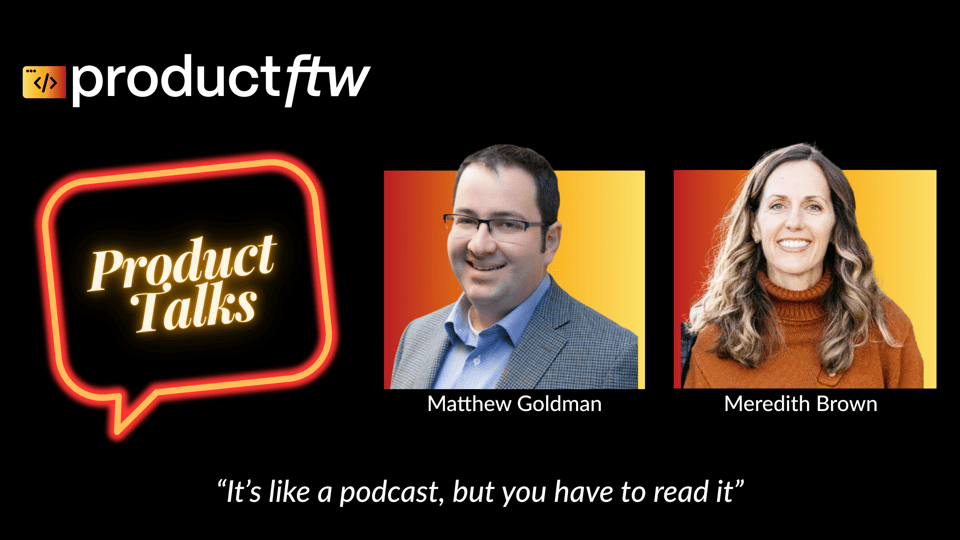
Matthew: Hey, Meredith. Let’s start with you telling me a little bit about yourself. I know you're about to start a new role, so you can tell me either where you work or where you have worked.
Meredith: Hi, I’m Meredith. I'm starting a new job at Smartsheet next week, where I'll be leading the enterprise and ecosystem product areas. I am coming out of a role as the chief product officer for a company called Pantheon.
Pantheon is a web ops platform for front-end developers, mostly for developers who are building their websites on Drupal, WordPress, or other sources of open-source technology. It's a platform that allows them to manage all of the different processes around getting a website to development and onto production. Pantheon does that with a good degree of quality, scale, and performance. I ran the Product and Design teams there for about 18 months, and that was a very different experience than some of the other roles I've had.
It’s a small company and it's privately owned. When I started, there were about 500 employees, and when I left, there were about 350. So, it went through a lot of organizational changes while I was there; I was running product and design, and then for a period of time, I was running engineering as well. So I definitely got a broad perspective in terms of not only how product works and how to lead product, but how design works alongside product. I also got perspective on some of the challenges that come with working alongside engineering and having responsibility for that function for a bit of time.
Matthew: I want to discuss that further, but I have some further intro questions I want to make sure I don't miss.
Meredith: Absolutely. Before I was at Pantheon, I was at Salesforce for almost nine years. So, I saw lots of different parts of the Salesforce ecosystem and then had the opportunity to be Head of Product and General Manager for the Pardot business, which is a B2B marketing automation platform.
Matthew: So, when you were growing up or going to university, what did you study, and what did you think you were going to do?
Meredith: This is such a good question because I'm thinking about that for my own kids, who are starting to think about college and my experience versus their experience. When I went to university, I studied Communications & English, and I had a minor in Spanish. So, I obviously did not have a Computer Science background. I was very much focused on the humanitiesSo, what do you think about the role of a chief product officer versus the role of a product manager at various levels?. When I came out of school, I still didn't know what I wanted to do. So then I went, and I got a Master's in Health Communication, and I thought that I was going to work in public health and do these big public health campaigns to try and convince people to change their behavior. But I quickly realized that that's a really hard career to go into when you have a lot of student loans. So I went into consulting, and I started working with different companies that had different business challenges and were using technology to solve them.
I realized that I really liked that creative process of figuring out what the problem is, how we can solve it, and also how we can work as a team. I was an athlete growing up; I played a lot of soccer and lacrosse, and I loved the team environment. I realized I would really enjoy it if I could marry what it is to work in a team environment and have really good communication, that's what led me more to product management. It was a pretty different way to get into it compared to the other path that many product leaders go through, which is coming from a computer science or engineering background. I came at it from more of the business and user end of the spectrum.
Matthew: What was your first product manager job?
Meredith: Well, I left consulting, and I went to Blue Shield of California and took on an internal role. What Blue Shield was doing at the time was trying to figure out how to take all of their manual, paper-based processes and digitize them. I was thinking about functionalities like member self-service, the providers submitting claims, how agents and brokers work in the ecosystem, and how employers go and buy health insurance and then onboard all of their employees. All of that work needed to completely change and transform.
I don't even know if we called it a product manager at the time, but I was the liaison between the e-business group and end users, and I had to figure out how to balance what we wanted to do as a company versus what it would look like for the end users. I quickly realized that to be a true product manager, I needed to build products that you price, package, and bring to market. At this point, I transitioned to AT&T Interactive, where you and I met. That was my first switch from an internally facing role as a product manager to an externally facing role, which eventually led me to Salesforce.
Matthew: So, if someone asks you what product management is or what you do as a product manager, how do you answer?
Meredith: I always say I'm the person who tries to figure out the value that we can deliver to our end users. I've always worked in a B2B context, so in that case, not only for our users but also for the business. So, how we think about products and thinking about things like, how do we develop them? How do we launch them in a way that gives value to an end user and also allows us to reach our business outcomes?
Matthew: One thing you touched on was in your role at Pantheon where you were leading other functions like design, which I think is very common for product leaders to manage, but also engineering. I'm personally seeing a lot more CPTO-type title roles. So, what do you think about the role of a chief product officer versus the role of a product manager at various levels? In your ideal world, what things are you responsible for? What structure would you prefer to work in if you were drawing the boxes?
Meredith: I think the biggest thing that I learned stepping into the CPO role is that your first team (in terms of who you’re working with) changes so much. If you're a product leader, your first team is your product peers, and maybe design and engineering. When you're stepping into a CPO role, you really have to think about the outcomes for the entire business. So you have to have a perspective not only on what's going on in product, design, and engineering, but you have to have a lot of empathy for sales, marketing, customer success, and all of these other functions because you're really an officer of the company.
You have to think much more strategically than just your product. I think that's probably the biggest difference between being a product leader and a CPO. It also means you might step into something like, “Hey, run engineering for four months.” You have to have that general leadership ability to be able to go in and understand what's going on in the ecosystem and understand how all the pieces fit together. It’s different from being a product leader, where the focus is on getting the product to market, making sure people are adopting it, and making sure we're hitting our revenue targets. You still do all of that as a CPO, but you also have all of these other things to think about from the perspective of what's happening across the company.
Matthew: I think your background is really interesting in terms of comparing the CPO role in a 300-500-person company versus the CPO and GM role you had inside Salesforce. What are some of the key differences in terms of how you approach part of being a "division," or, I don't know what term Salesforce uses, but an important leader, but in a bigger context? Like at AT&T, we had a CPO of AT&T Interactive, and then obviously with a much bigger company overall.
Meredith: I think the biggest difference was that at Salesforce, there was always another layer of escalation. If something was going on, you had an entire research team, legal team, and communications team; there was always another function that could own an escalation or a challenge—if there was something going on, there was always someone you could partner with.
When you work in a small company like Pantheon, where there are only 350 people, and you are the chief product officer, you're the person solving all those problems. It's a very different type of role where you roll up your sleeves, understand what the issue is, and move people through it. When I was at Salesforce, I felt like there were always mini-teams behind anything that we were working through.
Matthew: That's super interesting. Both of those platforms obviously have customers who want access to them all the time, so I’m curious about how you handle a situation where systems go down, or there’s some kind of security crisis or something like that. How close to the metal are you getting? Are you on incident calls, or are you asking your engineering leads to manage it? How do you deal with some of those challenges?
Meredith: Since I was a GM of the business at Salesforce, if there was a big issue, I was on many of those escalation/incident calls working with customers. So, being in a larger company doesn't get you away from that part of it.
But at Salesforce, there was a whole ecosystem around how that would work, a whole team that would own all of the operations. There was a whole implementation of pager duty. And it was a pretty well-oiled machine in terms of what happened when an incident happened; you got on Slack, and all of the communication was very streamlined.
When you compare that to a smaller company like Pantheon, all those things are in place, but maybe the processes aren't as mature. So you're kind of working through a lot of the playbooks and refining them as you go. I felt like the Salesforce playbook was pretty tight because it was such a big organization, and there were so many different pieces of the puzzle that had gone through incident management. At Pantheon, I was also writing a lot of the comms myself, whereas at Salesforce, there are more templates and more playbooks to lean into.
Matthew: That makes me think of when we had an incident once at Bankrate. It was a vendor mistake, but it caused inquiries to show up on people's credit reports that weren't supposed to. I went on Reddit to be like, “I'm the Head of Product at this company, and we're really sorry.” That was our comm strategy. Because it was blowing up in some subreddit about credit cards. It was a very, like you said, roll up your sleeves type of thing.
Meredith: Absolutely.
Matthew: So, shifting gears a little. If someone comes to you, and they’re in college or recently out of college, and says they want to be a product manager, what do you tell them about general advice, how to get into the role, or how they should think about it?
Meredith: I think, first of all, it depends on what kind of product you want to get into. Like, are you going to go into a consumer-facing product or a B2B product? Do you want to go into something like a platform and very technical, or something that has a lot of experiences and interactions?
And so the advice that I'm going to give is going to vary based on how they think about the types of products that they're curious about and they're interested in because there's a spectrum. So if someone's very technical, they're coming out of engineering, and they want to work on platforms, well, then I'm going to give them a set of advice around the types of companies that they should be looking at, the mentors that they should have. There's going to be a lot more of those product managers that maybe came up through the engineering ranks. If they want to go on the other side and do something that's really creative, I might say, how are your design skills? So it really does depend on the type of Product that you want to go into. And then once you have a sense of what kind of Product you want to be doing, gear your experiences towards being surrounded by people you're going to learn a ton from.
Matthew: Are there books, newsletters, tools, or experiences that you recommend to aspiring product managers?
Meredith: Absolutely. There are so many good resources out there that you and I didn’t have access to when we were younger product managers. I think Lenny's Podcast is great because he does a lot for leaders and individual contributors.
There are lots of different meetups out there where you can really build your network. For example, I'm going to this product leader summit next Thursday. Maybe you're not going to a product leader summit, but maybe you could go to some other sort of product management summit.
The other thing that this cohort of new product managers has that we didn't have is all of these amazing AI tools where they can have conversations about things that they're curious about. I personally like Perplexity because it gives me sources. I like to have a conversation with it, like, “Hey, I'm really curious about this framework,” and then you can ask it more questions and go in and get the resources.
So, if you're an aspiring product manager and you're not taking advantage of all of these amazing new tools, I think that’s a big miss.
Matthew: For sure. I normally ask in the context of your current job, but since you’re about to start a new job, you can pick any experience you want for this next question.
What do you use in terms of methodologies and tools? How do you actually build the software? What are some of the methodologies you use - are you strictly Agile? Is your preference something slightly different, like gung-ho Jira or hate Atlassian? What are you actually using on a day-to-day basis when you're building stuff?
Meredith: I came from an environment where we were using Jira, which was fine. I think that because I was a chief product officer and I had directors and VPs who reported to me, I expected them to be more involved in how we used the tooling.
For me, coming into a new role, it's probably more important to understand if we have a compelling vision that everyone is on board with and understands. Do we have a set of priorities, and do people know what they are? Tooling doesn't really matter to me as a leader as much as having that compelling vision alignment across the team around what we're working on and why. You have to move people together toward that vision and those outcomes. I spent a lot of time refining that vision and making sure that we were listening to our customers, understanding what was happening with our competitors, and listening to our internal stakeholders, too. I also ensure that the broader team, including engineering, really understands the why behind what we're building.
That's for my role, personally. I know there are other people who spend a lot of time on the tooling, but I put a lot of my energy into constantly communicating with the teams about what we're doing and why, making sure that they understand why we've put things in the priority order we have, and what we expect those outcomes to be.
Matthew: So, how do you ensure that alignment? It might not be a software tool; maybe it’s a method or process. Is it presentations? Is it OKRs? What do you like to do to bring folks together?
Meredith: I think it can be OKRs or whatever the company is using. What I do is start by examining the company's goals, and a lot of that starts at a fiscal year. Once I understand where the company's going and what we need to do, I then look at how I can translate that into a set of pillars, or whatever you want to call them. Pillars, strategic priorities—every company calls them something different.
I then create a list of things that we're going to work on within a certain period of time that is contextual to where the business is going. Typically, we have no more than ten. We then go through them as a team, and we make sure that there's time for feedback and then we figure out what the measures are around those ten things. We look at things like if there are any obstacles that might get in our way as we go through the goals. And then we run that through a quarterly business review and cycle. I like to come back to it halfway through the fiscal year and then refresh it with what new information we have at that point. Has our competitor done something? Has something in our business changed? Have we completed one of the things that we said we were going to do?
So we kind of refresh it and that's where we maybe become more Agile. It's not set in stone that we're going to do those ten things forever. We have to be agile and react to what's happening around us, but we do it within the context of a framework so that people have the right cadence in terms of how they work together and that predictability around understanding how we work together.
Matthew: How do you approach the cross-functional component of things? How do you communicate to your product or product design team? And also, as you mentioned, not just engineering but also sales or support or any of those other functions. What do you think is the best way as the Head of Product to use your influence to create that alignment around what you think are the right product priorities?
Meredith: I think it's a two-way street. We, as product leaders, have to listen to what's happening in sales and customer success. And hopefully they're collecting lots of data for us to help us understand what's happening. Like, are they losing deals because of something that's happening in the product? Are they winning because we're doing something really well? Do we have a lot of red accounts because of certain product issues? So, we hopefully have some good communication and feedback loops going through to help us really understand what's happening in the go-to-market teams.
I'm using that information to influence what's going to be important for the product team, so they can see their voice in some of the priorities. I also like to use monthly or quarterly business reviews to reinforce what we're working on and why. And if those other teams have new information that they want to bring to the table, they have a forum where they know that their voice will be heard. We're not always going to work on everything that they want, but they at least can understand how we're evaluating it and how we're making those decisions.
Matthew: Awesome. So, after all of that, what's the most rewarding part of product for you? Amongst some of these challenges and some of these good parts, what do you love about it?
Meredith: I think it kind of goes back to why I got into it. I love being in a team environment, having grown up playing team sports. I love the element of the Product launch being kind of like a game. We win sometimes, or maybe we'll lose, and we learn from it. I love that part of it. I love the people, the connection, the relationships, and getting people to work together through some sort of outcome.
The other part that's super rewarding for me is building something for a company in a B2B context, which is where I've mostly worked, and it helps them do something great within their company. Like if I change somebody's career trajectory because we made their life so much easier. If they come to you and say something like, “Every day I had to run this report, and it would take me months to do it, and now I can do it in two weeks.” Those types of things I always find super rewarding—when you're materially changing somebody's work life or the way that their business is run.
Matthew: You keep using this sports team analogy, which I love. What role do you think the PM is playing? Are they a player? Are they a coach, are they a General Manager, or are they something else? Like in the world of sports. And what player is the chief product officer playing when you think about that same analogy?
Meredith: I think the chief product officer is definitely like the coach, right? You have all these players on the field, and in my mind, I’m thinking about a basketball team where you're passing the ball around. So I think the chief product officer needs to understand that your different players have different skills. And that includes your engineers, your product managers, and your design team; everyone is on the court. You have to kind of understand how all of those pieces fit together. So, I think the CPO needs to be the coach of that.
One of the things that I always coach the product managers on my team on is that you don't have to do everything by yourself. You might be on a team with ten engineers, a really kick-ass designer, and a researcher; you can leverage them. They have so much knowledge as well. So, you should be looking at how you can bring out the best in your own team to get the best result for what you’re building.
I think sometimes product managers come into their career early stage, and they think that they have to do everything. And I'm like, you have so many smart people on your team - why would you do that? You should be looking at how you can get the best out of everyone. And then they're excited because maybe they're being stretched in a different way, or you're giving them an opportunity like getting on a customer call with you. So I think they should have that growth mindset and think beyond just being a product manager. You can actually be kind of like a coach for your smaller team as well, and help your engineers and your designers and your researchers and other folks grow their careers as well.
Matthew: I think it's really interesting. In fact, just the other day, I was having this discussion with a former CTO/friend of mine about the analogy that PMs are the CEO of the product. And the way that you're putting it, as a coach, is really interesting. It's a different role because, as a PM, you're on the team, but you're not necessarily the same as your teammates. Usually, not everyone directly reports to you in a management structure, but you're still a leader.
So, maybe this is a controversial one: Is the product manager the CEO? Also, what's the difference between you, in this case, as the chief product officer/coach and the product manager as the player/coach? How do you think about different approaches or tools that people need to leverage to play that role?
Meredith: The one thing that I don't like people thinking about the PM being the CEO is that you don't have control over how all of the company’s resources are allocated. And so I think that you could set yourself up for a lot of frustration. Like, if we tell our product manager that they’re the CEO of a part of the business, there could be some frustration if they don’t have enough resources, like engineers or designers. Like, I'm not the CEO. I have no agency here, so that's why I don't like that.
Matthew: That's fine. I've always hated that saying. I didn't want to lead the witness, but I've always hated that analogy. Having been both a CEO and a product manager, I think they're not the same job at all.
Meredith: Yeah. Because the ask of a product manager versus the ask of a CEO is very different. For a PM, we ask them to work with the resources they have, with what they know, and with what they're being asked to do. And the outcomes you're trying to drive are more around finding the best solution that you can. Which is a very different ask than being the CEO of your business. Because we're asking PMs to make trade-offs. We're asking them to sequence things, to make the hard calls, to think creatively. I would much rather them show up with that curiosity and that creativity and being able to collaborate with people; that's a very different expectation, I think, than saying, “Be the CEO of your product area.” Because what is the behavior that you ultimately want from your teams? You want them to be outcome-driven. You want them to be curious. You want them to be collaborative.
Matthew: How do you help PMs on your team learn to coach or influence the other folks they have to work with but who are not their direct management employees?
Meredith: Some people naturally have that skill set. I don't know if it's personality or what it is, but sometimes you're going to get lucky, and they're already super collaborative. Maybe it’s the way they're educating people coming out of school; they're familiar with project-based collaboration, and they know how to do it.
Occasionally, you do find the person who has the mentality of “No, I’m the product manager, so what I say goes.” If you have that mentality, it's not going to really work well for you. So I try to find opportunities where I can say to them, “Look, you have all these things on your plate. What if you gave this task to the Lead Engineer or this particular person and let them run with it for a little bit.” Get them to let go for a bit and encourage them to practice and to learn to trust their team and see what sort of results they can get.
Matthew: All right, so last question: How has product changed over your career, and what do you think the future of it looks like?
Meredith: I think that technology is always evolving; that's constant. And so knowing that technology will always change is something that I think we as product managers have to always lean into. There's so much that's happened in the last couple of years with AI and generative AI. I don't expect product managers to be the experts in every technology because it will change, but I do expect them to be able to adapt to change and know that change is coming. So, thinking about things like how you will adapt to it and what kind of frameworks you can always lean into. Because that change will come.
The one thing that won't change is that you have to understand what your customers are asking for in terms of the problems they want you to solve. How do you constantly remain curious to understand those problems, and how do you not give them exactly what they asked for but think creatively about how to solve their problems? It really comes down to problem-solving. I think that's the thing that will never change with product management; you will always be a problem solver.
Matthew: I agree. Awesome. Thanks for chatting with me today, Meredith!
About ProductFTW
ProductFTW is a biweekly newsletter about product management, with a focus on real-life experiences in startups. We want to help product leaders be successful by giving realistic approaches that aren’t for giant tech companies. We know you don’t have a full-time product designer on each team. We know your software probably hasn’t been used by millions of people worldwide–yet. We’re here to bridge the content gap from building your product and team to scaling it.
Part of the Product Talks series — interviews with experienced product managers across HopSkipDrive, Smartsheet, The Zebra, perigon°, ClosedLoop AI, and Totavi.