
Product Talks with Dave - ProductFTW #32
Exploring Product Leadership with Dave Lifson, CPO at ClosedLoop.AI
I’m excited to start a new series on ProductFTW we’re calling Product Talks. In this series, we’ll do one-on-one interviews with experienced product managers. Over the course of my almost 20 years in Product and startups, I’ve worked with many people whose careers have grown and matured in these roles, and I want to share their perspectives. I am learning a ton from these interviews and I hope you do, too!
I’m talking to Dave Lifson, CPO at ClosedLoop AI for our first edition. I first met Dave when he was the founder and CEO of Postling, a social media management startup, sometime in the early 2010s.
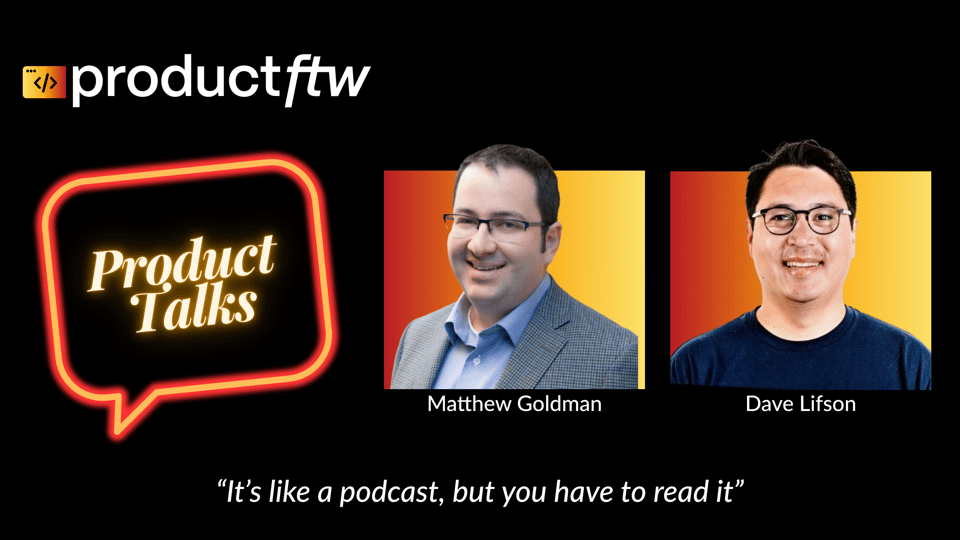
Matthew: Thank you for doing this interview. Let's start with an introduction.
Dave: I’m Dave. I’m currently the Chief Product Officer at ClosedLoop.AI, a health tech startup in Austin. The company’s at a unique point in its lifecycle—we’re technically a Series B company, but we’re pivoting, so it feels more like a pre-product-market fit startup. It’s been fascinating working in consumer health tech and with AI.
Matthew: What did you major in at university, and what did you think you were going to do when you grew up? Then how did you get into product?
Dave: I got into computers in middle school, and when I got to high school, my parents sent me to computer camp. I built my own PC by reading early how-to guides on tomshardware.com. At computer camp, I learned Basic, and then after we finished that curriculum, our teacher decided to teach us C (the programming language). By 16, I had learned JavaScript, and I wanted to be a Software Developer. I went to Cornell for undergrad, majoring in Computer Science, and completed my master’s there as well. My first job was at Amazon as a Software Developer, but I realized within the first year that all the things I really liked doing were things the product managers did. So, I transferred internally and joined as a PM on the Amazon Recommendations team.
Matthew: Product management is a thing that can mean different things in different contexts; what does it mean to you?
Dave: Product management has definitely evolved. Early on, it was more that we worked with the designers and the engineers to build the best version of an idea that someone else had, so it was mostly Project Management; it felt more like a support role. Now, I think of it as being responsible for answering, “What’s the most important problem to be solving?” We are able to decide on that strategy by understanding business strategy and analytics, speaking with users and stakeholders, and understanding the competitive environment. Knowing all this will tell us what product problems we should be solving. There’s also a sort of operational layer that’s also our job, which may include things like having a tech debt that’s affecting our velocity or maybe a strategic misalignment within the company. Generally, we are the problem solvers.
In that vein, I may have taken it further than other people do. I’ve given ownership over what solution we will be pursuing to my design and engineering teams. I want my PMs to figure out what the problems are, but I don’t expect them to be inventing the solutions - I turn to design and engineering to do that.
Matthew: How do you think the role of Line PM differs from what you do now as a Chief Product Officer, if at all?
Dave: The core goal of finding what the most important problem to solve is stays the same, but the scope of the problem area you are looking within gets more narrow the more entry-level you are. A junior PM might focus on a small and specific problem space, whereas after a couple of years, I may tell a PM what the problem is, and they are to focus on the execution piece. As you go further up the career ladder, the problem circle gets bigger and bigger until all of a sudden it’s the entire company or industry, and then you have to find the most important problem in a way larger space. As a CPO, I’m not writing Jira tickets or handling day-to-day execution. Instead, I ensure we have the right capabilities, data, and tools we need to make the right decisions, processes, and alignment across teams to execute effectively.
Matthew: I realize we skipped over a bit and didn’t talk about your experience very much. You don’t have to read me your resume, but can you share some highlights or interesting roles you’ve had from your career in product management, as well as the company stage or size?
Dave: I've worked in a variety of roles and at different company stages. I started at Amazon as a Software Developer, and while in that role, I ran a brown-bag lunch and an internal emailing list where I’d share interesting stories I read on TechCrunch. It got pretty popular, and it was actually what led to my first PM job. The Personalization Department was on the same floor as me, and they started attending the lunches as well, which is how they got to know me and made it easier for me to interview for a PM role when a position opened up.
One of the companies I came across on TechCrunch was Etsy, and I thought it looked like a cool company, so I decided to cold email them asking them to hire me so I could do Recommendations for them. The founder saw my email and thought adding Recommendations was a good idea, so I flew out for an interview. I realized while I was interviewing that the PMs there didn’t know how to do product, they were more Project Managers who were taking direction straight from the CEO. Once I understood the team a little more, I changed my pitch and instead said, “Why don’t you hire me to be your first Head of Product?” In hindsight, this was pretty ridiculous because I was 25 years old and had about 9 months of professional PM experience.
After about 6 months at Etsy, there was some restructuring, and I ended up leaving and starting my own company with the two engineering founders at Etsy, which we did for three years (it was called Postlink). I felt like we had built a really great product, but none of us knew anything about sales and marketing. As a Founder/CEO I should have forced myself to do those things or hire people who could, but instead, I stayed in my comfort zone of building product, and so we were never able to raise a Series A because we couldn’t prove we had scalable customer acquisition.
We ended up selling the company, and General Assembly hired me. When they offered me the job, the description had nothing to do with my experience. I spoke to my mentor, and he told me that I should just get on board in whatever position they offered me if I really believed that they would be a rocket. I did believe in the company, so I took the job. Over the next two years, I worked to build up their Education Product Team and their core curriculum, then switched to Digital Product Engineering.
I had a couple more years in startups, but eventually I hit a ceiling and I reached a point where I wanted to work with someone who was better at my job than I was to help me break through to the next level (I was tired of learning by failing on the job). I was able to find this at The Knot, which is a company that has had a huge impact on me. It taught me to shift my entire perspective to an outcome over outputs mentality, which opened up my eyes to how I had been living in a world of feature delivery. I was there for about 4.5 years and eventually made it to be SVP. For the last couple of years, I have been a CPO at two health-tech companies, with a year and a half in between the jobs with a very long and frustrating job search.
Matthew: You touched on this a little bit, but can you tell us a bit more about the unique challenges of being a CPO or Head of Product in a startup where the Founder often originally thinks of themselves as the Head of Product or the visionary? How do you balance things like tooling, execution, and process versus identifying what you are actually supposed to be working on?
Dave: Based on my experience, I believe that a pre-product-market fit startup should not hire a CPO, and you should not try to be the CPO for that company. At these companies, they may hire a Director of Product, but you should fully expect to be hired to execute other people’s ideas, which I think is appropriate. Pre-product-market fit is all about pivoting, searching, and finding the fit. In my experience, only the founder is able to do this in a way that the company needs, because they will most likely be able to connect dots that you can’t. If you do decide to join a pre-product-market fit startup, I would say don’t even bother trying to be the CPO in this situation unless you are comfortable with an execution role, which could be great for someone in the middle of their career.
Later on, the time when a CPO opportunity really shines is when they’ve found product market fit, and they are starting to scale. Here, two things start to happen: first, what used to work process-wise doesn’t work anymore because the company is a little bit bigger. Secondly, prioritization shifts from “What is the nearest dumpster fire that needs to be put out?” and gets turned into “We have a bunch of good ideas, how do we decide which of the good ideas to do first?” This is when a PM with a strength in strategy can really shine.
Matthew: Now that you have been doing this for a while and have a bunch of different experiences, what do you tell people who come to you who either want to become product managers or are in their first couple of years of product? What is your number one piece of advice?
Dave: Entry-level PM jobs don’t really exist, so I would say that the way to get an entry-level opportunity is to transfer internally. Don’t try to apply to entry-level jobs externally; join a company where you have some unique skillset (like a subject matter or expertise). If you do have an opportunity to join a company as a junior PM, don’t join a startup; the smallest I would go is a company that has around 10 PMs, which is a pretty big company. You’re going to need a lot of help, and if your manager is the only person you can turn to for help or to ask questions, I don’t think that you will get the support that you need. You want a senior person who is your peer, who can also be your mentor. When companies are smaller than 10 PMs, everyone is going to be at maximum capacity with their own workload, and they won’t have time to help you in the way that you need.
Matthew: Are there any go-to books, newsletters, or podcasts that you recommend to people who are trying to grow their skills? Other than your own.
Dave: Other than my own, I always recommend Ben Thompson’s newsletter, Stratechery. I’ve been a subscriber for over 7 years now. In addition, I would also recommend Lenny’s Newsletter, Marty Cagen and Teresa Torres. I have also heard from a lot of people that the Reforge resources are very good, but I haven’t used them myself.
Matthew: I think you’ve already touched on part of the answer to this question when you were talking about The Knot, but what do you think is one of the biggest lessons you’ve learned as a PM that changed the way you work or even more fundamentally, the way you think about building product?
Dave: We talked about outcomes over outputs a little bit - it used to be the case where I felt like I was constantly under pressure from my Founder to ship the roadmap faster. It was all about getting good at estimating ship dates and velocity, and we would inevitably miss our dates, then we felt like we were bad at our jobs because we missed the dates. As soon as we shipped something, we immediately moved to the next thing on the roadmap because there was so much to build and we had to constantly be building.
At The Knot, it shifted to become more of, “What are the outcomes that we're trying to achieve as a company?” Which was usually measured in terms of metrics and KPIs. Then, the teams were free to go and do whatever they needed to do, as long as the KPIs were going up. I no longer agree with that methodology either, but that was the first time where I felt like I was doing something really different. It was great because it gave the team a lot of autonomy to go and try a bunch of stuff, but the problem was that there was no strategy that tied all of the work together. Everyone was just focusing on optimizing their corner of the product, but nothing was stitching all of the pieces together into a bigger opportunity. We continued to build on that approach, though, and we soon decided that just going after the same KPIs each quarter (and making sure the numbers were going up) wasn’t a great idea, and we ended up developing a more strategic approach with a thread that drew everything together.
Matthew: If you came into an organization as Head of Product and you could snap your fingers and set the tooling set and the methodology for development that you’d use, what would your go-to or favorite set of tools and processes be?
Dave: In terms of software tools, I’m not really a tools guy, I will just use whatever the team prefers. Some of my ambivalence towards tools comes from when I was first learning to be a PM at Amazon, where we used Excel to manage our backlog because all these tools didn’t exist in 2007.
Something very important to me is that the PMs use a product brief. The product brief, for me, is not a product requirements document but more a document outlining what the problem is we are trying to solve, what metrics we’ve used to measure success, what our hypotheses are for what is going on, and what underlying assumptions must be true in order for our hypothesis to be true. I like to take those assumptions and then have the team figure out how to validate and de-risk them. The enemy that I am always trying to fight is the desire to just build the whole thing, ship it, and then find out if we were right or wrong. I try to pull forward the eventuality that we may fail while we make investments rather than after the fact.
We have started looking at greatquestion.co as a user research platform, they have an integration with respondent.io for recruiting user participants, and it seems like a useful tool for us so far. We’re also using MixPanel right now for funnel analysis. My advice would be to always have a BI tool, even if it’s just MetaBase (which is free), a funnel analysis tool, a user research platform tool, and hopefully connect all of your data in one place.
Matthew: What’s the most rewarding thing about being a product manager for you?
Dave: So I'm going to first tell you a little bit of a story, and then I'll give you an answer. Last year, I was working with a founder as a consultant, and she brought in her executive coach. In our first meeting, it was like a two-on-one. It was almost like a couples therapy session. And so this coach asked the both of us, the founder and then myself, “What are your short-term goals for working together, and what are your long-term goals?” And for me, and this is the answer to your question, the long-term goal for me is that I just want to make a difference; I want to have an impact. I want people to have a richer experience in their lives in some kind of way. This is why I've never really worked on Enterprise SaaS B2B software. It doesn't deliver enough reward to the user to satisfy me. The founder's answer was she wanted to be on the cover of every magazine; she wanted everyone to know who she was. And that goes to show just how much of a difference between the personality type of some founders and then product. So I guess my answer is, I just want to make a difference and make an impact.
Matthew: What do you think the future looks like, and how has product changed in the time you’ve been doing it professionally?
Dave: Okay, so I don't know if we could have spent an entire session on this question because my day-to-day now is building a product on top of an LLM. It is fascinating how different it is in terms of the product development process. And what I mean by that is, up until now, my entire career, product has been something where on the day you start, there is zero functionality, and so your product can do nothing. Then you think about all the use cases and the user journey, and then you build all these different screens and features, and you lead people down these funnels that you create for them that get them from start to finish.
In an LLM world, out of the box on day one, it can handle infinite input and give back infinite output. It’s of unknown quality, accuracy, and trustworthiness, but it will answer every question. From these infinite use cases and capabilities, you then need to shrink it all the way back down to whatever you think the product-market fit is and then scale from there. And so instead of this, like, zero to one to 100 progression, it's like infinity to one to one hundred. And it's bonkers. It's really, really fun. But it's so much more about immersion design and trying to be adaptive to how your users will use your product in ways that you never thought of. It's a really interesting time.
About ProductFTW
ProductFTW is a biweekly newsletter about product management, with a focus on real-life experiences in startups. We want to help product leaders be successful by giving realistic approaches that aren’t for giant tech companies. We know you don’t have a full-time product designer on each team. We know your software probably hasn’t been used by millions of people worldwide–yet. We’re here to bridge the content gap from building your product and team to scaling it.
Part of the Product Talks series — interviews with experienced product managers across HopSkipDrive, Smartsheet, The Zebra, perigon°, ClosedLoop AI, and Totavi.